FBI Seizes Domain of Criminal-Dedicated 'Bulletproof Hosting' Service Virtualine in 'Operation OmegaLine' Coordinated with Germany, the Netherlands, and the UK
ALEXANDRIA, Va.
The Federal Bureau of Investigation (FBI) has seized the website domain of Virtualine, a so-called "bulletproof" hosting service that supported criminal activities including ransomware, the distribution of child sexual abuse material, and international money laundering. According to the U.S. Attorney's Office for the Eastern District of Virginia (EDVA), First Assistant U.S. Attorney Theophani K. Stamos for the Eastern District of Virginia and Special Agent in Charge Darren B. Cox of the FBI Washington Field Office announced the seizure of virtualine.net on October 27 (local time).
Prosecutors announced that the website was used to commit and facilitate prolific criminal activity, including advertising sexually explicit images of minors, intentionally disclosing nonconsensual intimate visual depictions of adults and minors, and international money laundering to conceal and promote criminal acts.
The website Virtualine was seized after being used for prolific criminal activity, including advertising sexually explicit images of minors, disclosure of nonconsensual intimate visual depictions, and international money laundering.@FBIWFO https://t.co/1O7lnY2Vjw
— U.S. Attorney EDVA (@EDVAnews) 2026년 10월 27일
Seized with Court Authorization... Operated Under Multiple Names Including 'Secury', 'Massgod', and 'Omegatech'
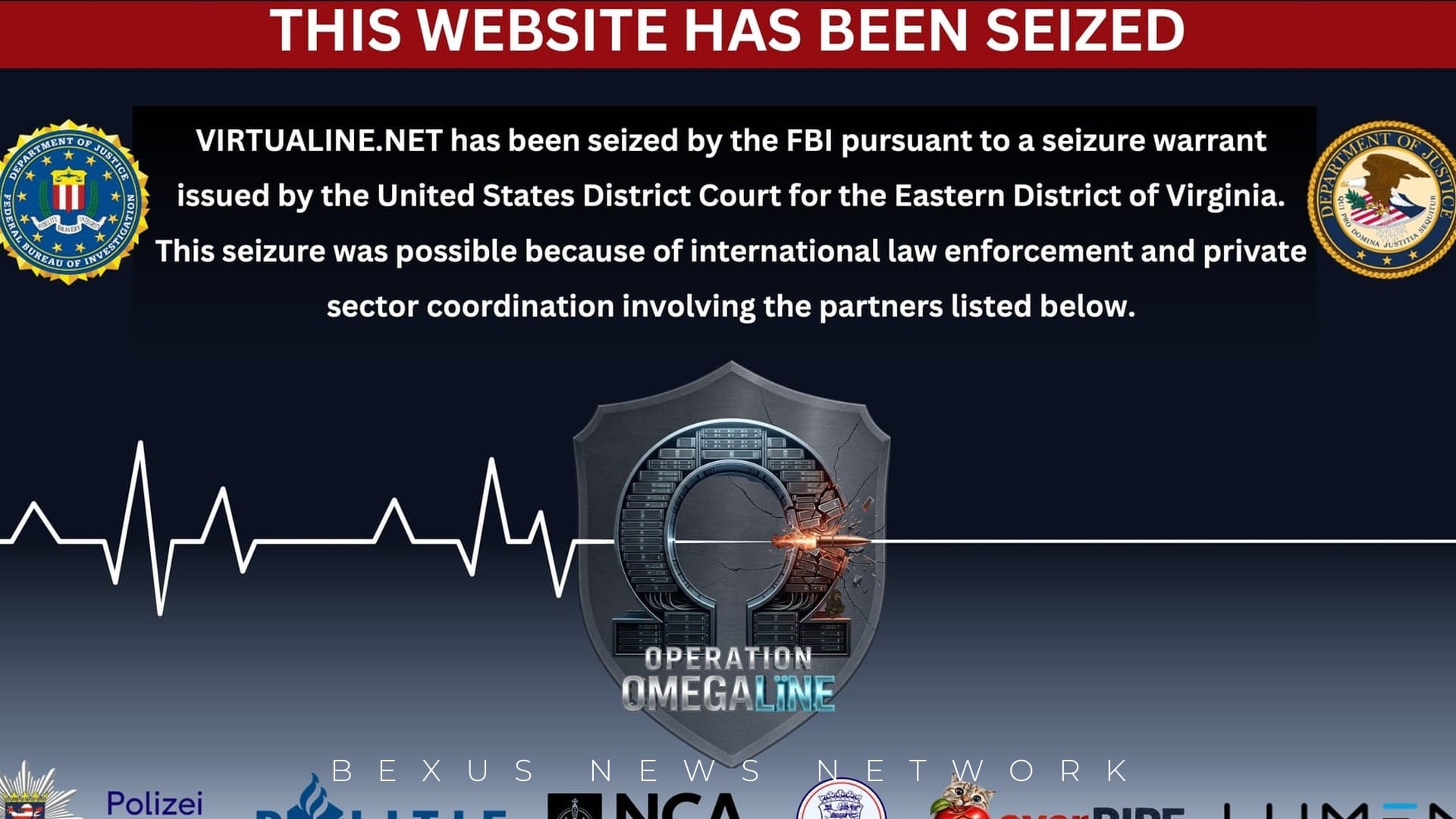
According to court records, the U.S. government seized virtualine.net pursuant to court authorization. The domain was the website of Virtualine, which also operated under the names Secury, Massgod, Spamhouse, Lanedo, and Omegatech. A notice displayed on the seized website states: "VIRTUALINE.NET has been seized by the Federal Bureau of Investigation pursuant to a seizure warrant issued by the United States District Court for the Eastern District of Virginia" and "This seizure was accomplished in collaboration with international law enforcement and private sector partners listed below."
According to prosecutors, Virtualine was a "bulletproof" service providing hosting and server services along with domain purchasing options, advertising its services to criminals on cybercrime forums.
"Can Be Used for Any Illegal Activity Except Child Content and Terror"
According to court records released by prosecutors, Virtualine told a user on the cybercrime forum Exploit.in in September 2024 that Virtualine could be used for "any illegal / blackhat activity (phishing, carding, spams, port scanning, EVERYTHING except child content and terror activity)."
In March 2026, Virtualine advertised an "additional protection plan" offered to clients who "received an official request from law enforcement." Under this plan, Virtualine promised to move the customer's criminal infrastructure to "another shell company unrelated to Virtualine and restart the servers." In June 2025, Virtualine advertised to users of the hacking forum HackForums that "Virtualine ignored more abuse than your last three therapists."
Continued Hosting 'Vendor 1' Despite Repeated Child Sexual Abuse Material Reports
According to prosecutors, while Virtualine advertised that it did not allow "child content" on its servers, it knowingly hosted a website designated in court records as "Vendor 1." Vendor 1 was an online criminal forum where users uploaded and sold access to nude, sexually suggestive, or explicit images and videos of minors and adults. Vendor 1 also promoted "hack-for-hire" services allowing users to pay hackers to access victims' online accounts without consent and unlawfully exfiltrate explicit images and videos.
According to prosecutors, beginning in January 2026, approximately one month after assigning IP addresses to Vendor 1, Virtualine began receiving notifications that the servers contained sexually explicit images and videos of minors. Prosecutors announced that Virtualine continued hosting Vendor 1's services despite receiving numerous notifications from law enforcement agencies in Germany, Canada, and Australia, the U.S. National Center for Missing and Exploited Children (NCMEC), and even an attorney representing a victim.
According to prosecutors, Virtualine worked closely with Vendor 1 to create a new website where Vendor 1's customers could upload illegal content and download it upon purchase. Virtualine continues to host this new website, on which at least one report concerning sexually explicit images of a child had already been received.
'BTC [NO-AML]' Payments... Criminal Proceeds Relaundered
According to prosecutors, virtualine.net offered multiple payment methods to customers, including Vendor 1. Virtualine accepted payments via a method labeled "BTC [NO-AML]," in which customers sent funds directly to specific unhosted Bitcoin addresses without concern that the funds would be flagged as illicit. Portions of the funds paid to Virtualine by criminal clients traced directly to multiple criminal organizations, and prosecutors stated that Virtualine relaundered these funds after receiving them to conceal their source.
On October 28, the FBI Cyber Division announced on its official X account that "The FBI and the U.S. Department of Justice have announced the disruption of Virtualine, a so-called 'bulletproof hosting' service designed to help cybercriminals evade detection and law enforcement action." The FBI Cyber Division stated, "Before the FBI and its partners shut it down, the Virtualine[.]net domain was used to facilitate child sexual abuse material (CSAM) distribution, international money laundering, and numerous other cybercrimes."
The @FBI and @TheJusticeDept have announced the disruption of Virtualine, a so-called “bulletproof hosting” service designed to help cybercriminals evade detection and law enforcement action.
— FBI Cyber Branch (@FBICyberBranch) 2026년 10월 28일
Before the FBI and its partners shut it down, the Virtualine[.]net domain was used to… pic.twitter.com/Md8sdX2ku1
Dutch Police Seize Dozens of Servers at Limburg Data Center... "Data of Over 3,000 Customers Secured"
According to the EDVA, the case was investigated by the FBI Washington Field Office, with significant assistance provided by the Hessen State Police (Polizei Hessen) of Germany, the Central Netherlands Police (Politie Midden-Nederland), the UK's National Crime Agency (NCA), and private sector partners OverRIPE and Lumen. The U.S. Department of Justice Office of International Affairs (OIA) also provided assistance.
In an announcement on October 28, the Dutch police stated that the Central Netherlands Police Cybercrime Team seized dozens of servers belonging to a malicious hosting provider as part of an international investigation. According to Dutch police, the company is suspected of facilitating cybercrime, presenting itself as a "bulletproof hosting provider," advertising complete anonymity for users, and giving the impression that it ignores reports and requests from investigative authorities.
Dutch police announced that since 2022, the provider was involved in facilitating ransomware attacks, botnets, infostealers, phishing campaigns, and the dissemination of child sexual abuse material. Police announced that through the seizure, they obtained data and information on more than 3,000 customers who used the servers for criminal activities, and follow-up actions against these users are currently underway.
According to Dutch police, dozens of physical servers located at a data center in the province of Limburg were seized, which also took hundreds of virtual servers offline. The secured data will be used in further investigations into customers who used these servers for criminal purposes. Dutch police stated that during the international coordinated operation, the FBI and German police simultaneously conducted operations targeting suspects, seizing cryptocurrency, and executing the international disruption and takedown of infrastructure.
On October 30, the FBI Washington Field Office announced on its official X account that "With the assistance of our partners in Germany, the Netherlands, and the United Kingdom, #FBIWFO seized Virtualine's website, which facilitated criminal activity, including the advertisement of child sexual abuse material, nonconsensual intimate imagery, and international money laundering." The post tagged accounts for the U.S. Attorney's Office for the Eastern District of Virginia, the State Criminal Police Office of Hesse (LKA Hessen), the UK National Crime Agency, and the Dutch Police.
“Bulletproof” Website Domain Seized in International Law Enforcement Operation: With the assistance of our partners in Germany, the Netherlands, and the United Kingdom, #FBIWFO seized Virtualine's website, which facilitated criminal activity, including the advertisement of child… pic.twitter.com/ZYTlPNgT1t
— FBI Washington Field (@FBIWFO) 2026년 10월 30일
CISA: "Bulletproof Hosting Is a Key Enabler of Modern Cybercrime"
On November 19, 2025, the U.S. Cybersecurity and Infrastructure Security Agency (CISA), alongside domestic and international partners, released a guide to combat bulletproof hosting titled "Bulletproof Defense: Mitigating Risks from Bulletproof Hosting Providers." According to CISA, the guide was developed through the Joint Ransomware Task Force, an interagency body of the U.S. government.
CISA stated that cybercriminals are increasingly utilizing bulletproof hosting infrastructure to conduct cyber operations against high-value targets, including critical infrastructure and financial institutions. According to CISA, bulletproof hosting providers sell infrastructure to criminals as "bulletproof" because they do not comply in good faith with legal processes or respond to abuse complaints from third parties or victims regarding malicious activity hosted on their systems. Criminals use this infrastructure for command and control (C2), malware distribution, phishing, and hosting illicit content to execute ransomware, data extortion, and denial-of-service (DoS) attacks.
Madhu Gottumukkala, Acting Director of CISA, said in the announcement, "Bulletproof hosting is one of the key enablers of modern cybercrime," adding, "By shining a light on this illicit infrastructure and providing concrete steps for defenders, we're making it harder for criminals to hide and easier for partners to safeguard the systems Americans rely on every day." CISA recommended that Internet service providers (ISPs) and network defenders perform traffic analysis, maintain and periodically review lists of "high-confidence" malicious internet resources, and offer filters for customers to apply. Nick Andersen, Executive Assistant Director for Cybersecurity at CISA, said, "As bulletproof hosting providers become increasingly common accomplices, they pose an imminent and severe risk to the resilience and safety of vital systems and services," adding, "CISA's international collaborations across government, law enforcement, and the private sector are making it harder for cyber criminals to remain anonymous online."
Netherlands Revises Notice and Take Down Code of Conduct... Minister of Justice Addresses 'Bad Hosting'
Dutch police stated that hosting providers hold a critical position linking the online and physical worlds. To respond more rapidly and effectively to online abuse, the Dutch internet sector recently revised its "Code of Conduct on Combating Abuse (Gedragscode Abusebestrijding)" and "Notice and Take Down (NTD) Code of Conduct." The codes urge hosting services and online platforms to remove or disable access to illegal online content immediately upon becoming aware of it.
Dutch police noted that political authorities are also paying close attention to the issue of "bad hosting," citing a letter sent to parliament by Minister of Justice and Security van Weel on July 6, 2026. Dutch police stated that while the vast majority of the Dutch hosting industry takes measures on its own to prevent criminals from using its services, some facilitate malicious activities unintentionally ("bad hosting") or intentionally ("bulletproof hosting"). In response, the government is pursuing criminal and administrative measures, collaborating closely with administrative authorities, and maintaining contact with major internet companies.
Assistant U.S. Attorneys Laura D. Withers and Stefanie A. Schwartz of the Eastern District of Virginia are prosecuting the case.
Sources (KST)
- U.S. Attorney's Office for the Eastern District of Virginia press release, ""Bulletproof" website domain seized in international law enforcement operation" (October 27, 2026): https://www.justice.gov/usao-edva/pr/bulletproof-website-domain-seized-international-law-enforcement-operation
- Dutch Police press release, "Internationale politieactie tegen bulletproof hoster" (October 28, 2026): https://www.politie.nl/nieuws/2026/oktober/28/03-internationale-actie-tegen-bulletproof-hoster.html
- Cybersecurity and Infrastructure Security Agency (CISA) press release, "CISA Unveils Guide to Combat Bulletproof Hosting Cybercrime" (November 19, 2025): https://www.cisa.gov/news-events/news/cisa-unveils-guide-combat-bulletproof-hosting-cybercrime
- U.S. Attorney's Office for the Eastern District of Virginia X post: https://x.com/EDVAnews/status/2115149760952983639
- FBI Cyber Branch X post: https://x.com/FBICyberBranch/status/2115534240896991424
- FBI Washington Field Office X post: https://x.com/FBIWFO/status/2116168599555408032