UK and Polish Defence Ministers Sign Three-Year "Warsaw Defence Plan" to Develop Air Defence Missiles and Counter-Drone Systems, Announce Next Month's "Coalition of the Willing" Exercise
Warsaw, Poland
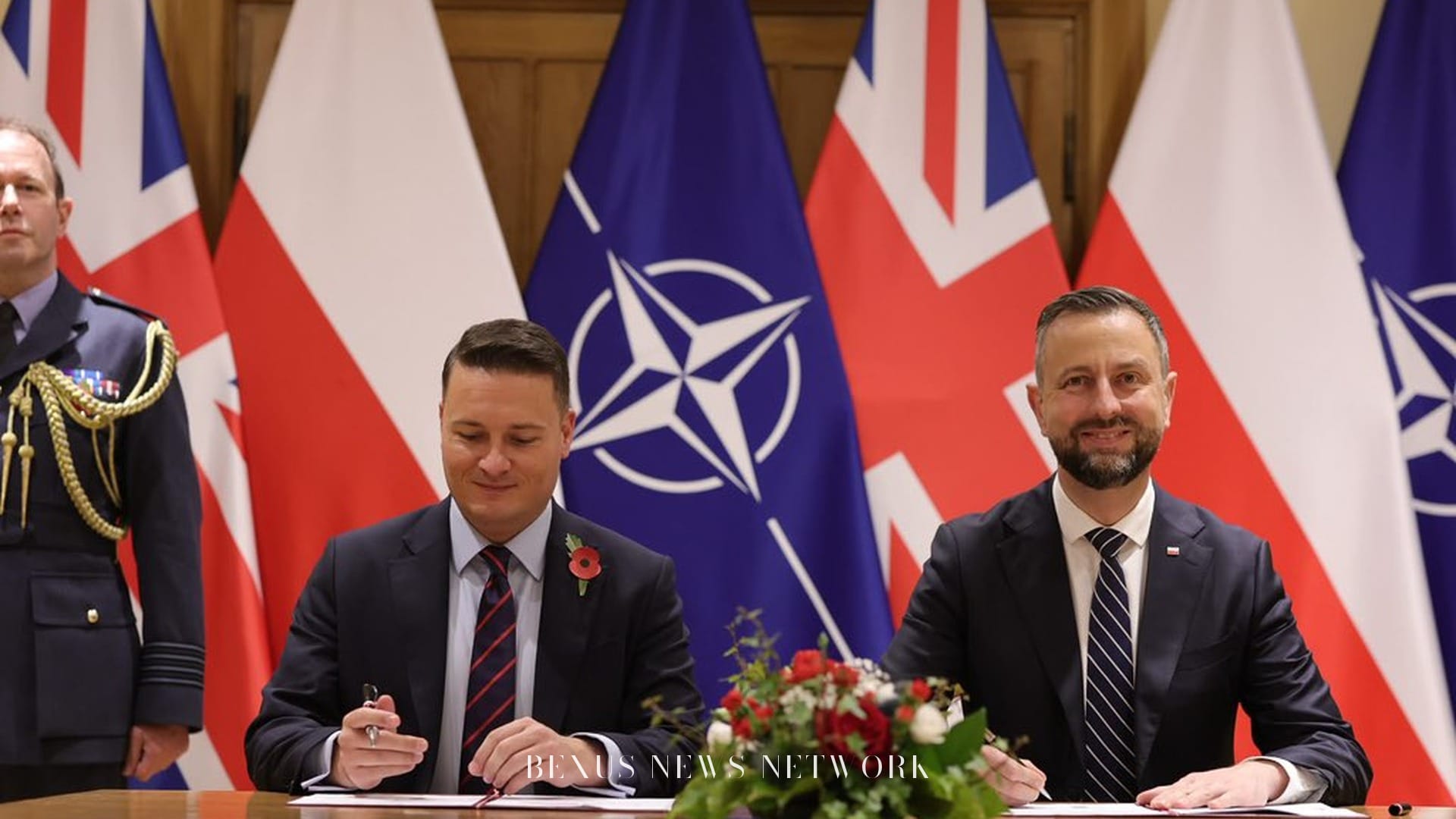
The defence ministers of the United Kingdom and Poland met in Warsaw, Poland, on October 27, 2026, and signed a three-year plan setting the direction for bilateral defence cooperation. The signing was led by UK Defence Secretary Wes Streeting and Polish Deputy Prime Minister and Minister of National Defence Władysław Kosiniak-Kamysz. The UK Ministry of Defence referred to this document as the "Warsaw Defence Plan," announcing that the plan will make the UK safer and represents the first phase of defence cooperation under the UK-Poland Security and Defence Partnership Treaty concluded by the two nations in May this year. The Polish Ministry of National Defence referred to the same document as the "Three-Year Defence Cooperation Plan (Plan Współpracy Obronnej)," announcing that it sets the strategic direction for cooperation between the armed forces of both nations "through the end of this decade." The UK Ministry of Defence stated that the objective of the plan is "deterring Russian threats." In the same announcement, the UK Ministry of Defence added that the UK and Poland are planning a large-scale "Coalition of the Willing" exercise involving thousands of personnel in Poland next month. The Coalition of the Willing is a consultative group of European and other nations united in their commitment to supporting Ukraine's security following the war.
UK Ministry of Defence announces the plan spans maritime, land, air, cyber, and industrial domains
According to the UK Ministry of Defence announcement, under the Warsaw Defence Plan, the two countries will work together across the maritime, land, air, cyber, and industrial domains to strengthen the security and deterrence of "Europe's Eastern Flank." The Eastern Flank refers to the region of NATO member states in the east bordering Russia and Belarus. The UK Ministry of Defence singled out five key areas. First is cooperation on the manufacturing and development of next-generation air defence missiles. Second is the joint development of uncrewed aerial vehicles and counter-drone technologies. The UK Ministry of Defence added to this item the explanation that it is intended "to deter threats against civilians and critical national infrastructure as Russia steps up its campaign of drone incursions across the UK and Europe." Third is cyber security and resilience cooperation to protect defence and civilian facilities from hostile threats.
Fourth is the sharing of frigate development expertise. The Royal Navy's Type 31 frigate and the Polish Navy's Miecznik frigate are being built based on the same design. Fifth is increasing defensive maritime activities through exercises and regional coordination in the Baltic Sea. The UK Ministry of Defence announced that this will enable both nations' armed forces to protect critical sea lanes of communication.
Immediately after the signing, Secretary Streeting wrote on X, "Poland and Britain’s long and close alliance has been furthered today by the signing of the Warsaw Defence Plan," adding, "which will boost our collective capacity and capability in the stronger Europe and stronger NATO we need for a safer Britain."
Poland and Britain’s long and close alliance has been furthered today by the signing of the Warsaw Defence Plan, which will boost our collective capacity and capability in the stronger Europe and stronger NATO we need for a safer Britain. 🇬🇧🤝🇵🇱 pic.twitter.com/RiUJXj0eMU
— Wes Streeting (@wesstreeting) October 27, 2026
In the UK Ministry of Defence announcement, Secretary Streeting referred to Poland as "one of our closest allies," citing their shared history of fighting together in the Battle of Britain and breaking the Enigma code. He stated, "From working together to deter our adversaries during NATO exercises, to standing together in support of Ukraine as they fight for their freedom, we will stand together for European security."
Minister Kosiniak-Kamysz cites Miecznik, Narew, Pilica, and submarine project as examples of cooperation
According to the Polish Ministry of National Defence, Deputy Minister of National Defence Paweł Zalewski also attended the meeting on this day. After the meeting, Minister Kosiniak-Kamysz stated, "The United Kingdom is a very important partner for us in arms production," and cited collaborative projects one by one. He stated, "The next stages of the Miecznik program are proceeding according to plan," and cited the integrated air defence network projects Narew, Pilica, Pilica+, and the establishment of an independent 155mm artillery ammunition production line as "part of our joint initiatives." Narew is Poland's short-range air defence system program, and Pilica is an even shorter-range very-short-range air defence system program. He stated, "One of the largest air defence investments is being carried out in cooperation with the United Kingdom."
Minister Kosiniak-Kamysz said that the United Kingdom is also involved in Poland's submarine selection. He stated, "Poland's choice of submarines and selection of the Swedish partner also resulted from cooperation with the British side, and the UK will play a significant role in this process," calling it "one of the most important decisions we have made recently."
The Polish Ministry of National Defence posted news of the signing on its official X account, alongside a photograph of the meeting between the two ministers and Deputy Minister Zalewski.
Strategiczne partnerstwo Polski i Wielkiej Brytanii. Podpisano trzyletni Plan Współpracy Obronnej
— Ministerstwo Obrony Narodowej 🇵🇱 (@MON_GOV_PL) October 27, 2026
-
27 października 2026 roku w Warszawie, odbyło się spotkanie dwustronne wicepremiera W. @KosiniakKamysz 🇵🇱 z sekretarzem obrony 🇬🇧@wesstreeting. W rozmowach delegacji obu państw… pic.twitter.com/JP9v0wKVC7
In a separate post on X, the Polish Ministry of National Defence conveyed Minister Kosiniak-Kamysz's remarks, writing that the list of cooperation projects with the UK is "only a part of our joint initiatives." In an announcement on September 7, the UK Ministry of Defence stated that the Miecznik program is a project to jointly develop with the UK three frigates based on the "Arrowhead" design similar to the UK Babcock's Type 31, and announced that the first Arrowhead frigate had been launched "last month." In the same announcement, the UK Ministry of Defence called Pilica+ a "multi-billion-pound programme to build an integrated air defence system protecting Polish skies with the UK."
According to the UK Ministry of Defence announcement, the two nations will expand defence industrial cooperation by strengthening defence procurement coordination. The UK Ministry of Defence cited as an example Poland's contract to acquire the Narew air defence system from MBDA UK. In its September 7 announcement, the UK Ministry of Defence placed the scale of the Narew cooperation at "over £4 billion," stating that the project will supply Poland with over 1,000 air defence missiles and over 100 launchers, while enabling Poland to establish sovereign missile manufacturing capabilities. According to the same announcement, MBDA opened a maintenance and logistics facility for Pilica+ in Czosnów, Poland. Under the current plan, the UK's BAE Systems and Polish state-owned defence group PGZ will jointly increase production capacity for large-calibre ammunition.
The two ministers made Russian drone incursions and support for Ukraine the starting point of their talks
Minister Kosiniak-Kamysz said, "An important topic with which we began the talks was support for Ukraine." He stated, "The tyranny, oppressive and neo-imperial policy of the Russian Federation has plagued Ukraine since 2014, when it occupied Crimea, and subsequently led to a full-scale war," adding, "The answer of Poland and the United Kingdom is clear: we will defend freedom with all our might, and we will defend our rights and every inch of our land."
In remarks released by the Polish Ministry of National Defence, Secretary Streeting said, "We hear very clearly what Poland is experiencing every day, which some call Russia's hybrid threat," adding, "I prefer to call it state-sponsored terrorism." Hybrid threats refer to attacks blending measures short of armed aggression, such as sabotage, cyberattacks, drone incursions, and disinformation. Streeting noted that Polish armed forces and air defences are mobilized daily against drone incursions, stating, "Putin is testing us and testing NATO's resolve, not only in Poland, but across the entire NATO alliance." He continued, "In this contest between freedom and tyranny, Britain and Poland will not be passive observers," adding, "When Poland speaks, Britain answers."
In remarks posted on X by the Polish Ministry of National Defence, Minister Kosiniak-Kamysz said, "Poland and the UK are doing everything to assist Ukraine in its fight against Russian tyranny," adding, "Our joint statement is a very strong message saying it remains to be seen whether the 21st century will be defined by the freedom we hold dear or the tyranny brought by the Russian Federation." Secretary Streeting stated, "What we are doing here today builds our capabilities, builds our defence industrial potential, and above all, strengthens our alliance," calling Poland "one of Europe's greatest and certainly most reliable friends."
Minister Kosiniak-Kamysz stated that the UK and Poland share a similar view of their alliance with the United States. He said, "Poland and the United Kingdom support strengthening the transatlantic alliance," adding, "We are in favour of building our own capabilities and increasing European independence, but not independence from the United States."
Both nations to hold 'Coalition of the Willing' exercise in Poland next month to inspect Multinational Force Ukraine readiness
According to the UK Ministry of Defence, the two countries will continue to participate in major exercises such as Steadfast Defender, Polish Dragon, and Joint Warrior to prepare for future conflicts, including counter-drone warfare, electronic warfare, and missile defence. Steadfast Defender is a large-scale NATO exercise, and Joint Warrior is a multinational exercise hosted by the United Kingdom.
The UK Ministry of Defence announced that the two nations are planning a large-scale Coalition of the Willing exercise in Poland next month. According to the UK Ministry of Defence, thousands of personnel will participate in this exercise, which aims to verify the readiness of the "Multinational Force Ukraine" to support military training and post-war reconstruction that Ukraine will require.
On his personal X account, Minister Kosiniak-Kamysz wrote, "This plan is about three things: more modern weaponry, joint training of soldiers, and better preparation for defence in case of threats." He wrote, "This cooperation is already working," noting that British soldiers are serving in Poland and training alongside Polish troops in Nowa Dęba, adding, "The more we produce and train together, the more strongly we deter the adversary."
Polska i Wielka Brytania podpisały trzyletni Plan Współpracy Obronnej! 🇵🇱🇬🇧
— Władysław Kosiniak-Kamysz (@KosiniakKamysz) October 27, 2026
Chodzi o trzy rzeczy - więcej nowoczesnego uzbrojenia, wspólne szkolenie żołnierzy i lepsze przygotowanie do obrony w razie zagrożenia.
Ta współpraca już działa. Brytyjscy żołnierze służą w Polsce i… pic.twitter.com/QebpwMc5A3
The UK-Poland Security and Defence Partnership Treaty, which serves as the foundation for this plan, stipulates in the treaty text laid before the UK Parliament that both nations, as "NATO Allies and strategic partners, deeply committed to mutual defence," will "assist each other, including through military means, in accordance with Article 5 of the North Atlantic Treaty" should either be the victim of an armed attack. The treaty text stipulates that the two countries will continue to develop detailed plans for military cooperation through the Defence Cooperation Plan established under the 2017 treaty, and mandated an annual Strategic Dialogue attended by ministers, Chiefs of Defence, and senior officials. When the treaty was signed in May, the UK Ministry of Defence announced that the two nations had designated the joint development of air- and land-based air defence missiles, expanding large-calibre ammunition production, strengthening deterrence by forward land forces on the Eastern Flank, North Sea and Baltic Sea maritime security, and cyber defence as priority projects. In the same announcement, UK authorities stated that both nations are experiencing an increase in cyberattacks from criminal organizations and hostile state actors, alongside growing hybrid threats particularly from Russia. In response, UK authorities announced they would establish a "UK-Poland Counter-Hybrid Working Group," form a joint task force of civilian agencies from both nations to counter the hostile use of uncrewed aerial vehicles, and strengthen sanctions enforcement coordination regarding Russia's aggression against Ukraine and shadow fleet operations. The shadow fleet refers to a fleet of aging tankers that transport Russian crude oil and other products while evading sanctions. Article 3 of the treaty text stipulates strengthening bilateral cooperation against threats to critical infrastructure, including land- and sea-based infrastructure. The Polish Ministry of National Defence announced that during this meeting, the two ministers discussed adapting their armed forces to hybrid threats, equipping NATO's Eastern Flank with modern deterrence capabilities, and strengthening industrial cooperation, while reaffirming complete unity and coordination in supporting Ukraine.
Sources (KST)
- UK Ministry of Defence, "UK and Poland strengthen defences on Europe's Eastern flank" (October 27, 2026): https://www.gov.uk/government/news/uk-and-poland-strengthen-defences-on-europes-eastern-flank--2
- Polish Ministry of National Defence, "Strategiczne partnerstwo Polski i Wielkiej Brytanii. Podpisano trzyletni Plan Współpracy Obronnej" (October 27, 2026): https://www.gov.pl/web/obrona-narodowa/strategiczne-partnerstwo-polski-i-wielkiej-brytanii-podpisano-trzyletni-plan-wspolpracy-obronnej
- UK Ministry of Defence, "UK expertise to bolster Polish air defences in boost to NATO security" (September 7, 2026): https://www.gov.uk/government/news/uk-expertise-to-bolster-polish-air-defences-in-boost-to-nato-security
- UK Government, "Security and Defence Partnership Treaty: the projects the UK and Poland will deliver together" (May 27, 2026): https://www.gov.uk/government/news/security-and-defence-partnership-treaty-the-projects-the-uk-and-poland-will-deliver-together
- Treaty text presented to the UK Parliament, "Treaty between the United Kingdom and the Republic of Poland on a Security and Defence Partnership" (CS Poland No.1/2026): https://assets.publishing.service.gov.uk/media/6aa4088292e72b8ac437f1ca/CS_Poland_1.2026_Treaty_Security_Defence_Partnership_correction.pdf
- UK Defence Secretary Wes Streeting's X post (October 27, 2026): https://x.com/wesstreeting/status/2115159543114273020
- Polish Ministry of National Defence X post (October 27, 2026): https://x.com/MON_GOV_PL/status/2115039405610004791
- Polish Minister of National Defence Władysław Kosiniak-Kamysz's X post (October 27, 2026): https://x.com/KosiniakKamysz/status/2115040388343857359