Ukrainian Ministry of Defence Holds Working Meeting on Domestic Implementation of NATO SOFA; 18 State Agencies Attend, Discuss Directions for Legislative Amendments on Criminal Jurisdiction, Compensation, Customs, and Taxation
Kyiv, Ukraine
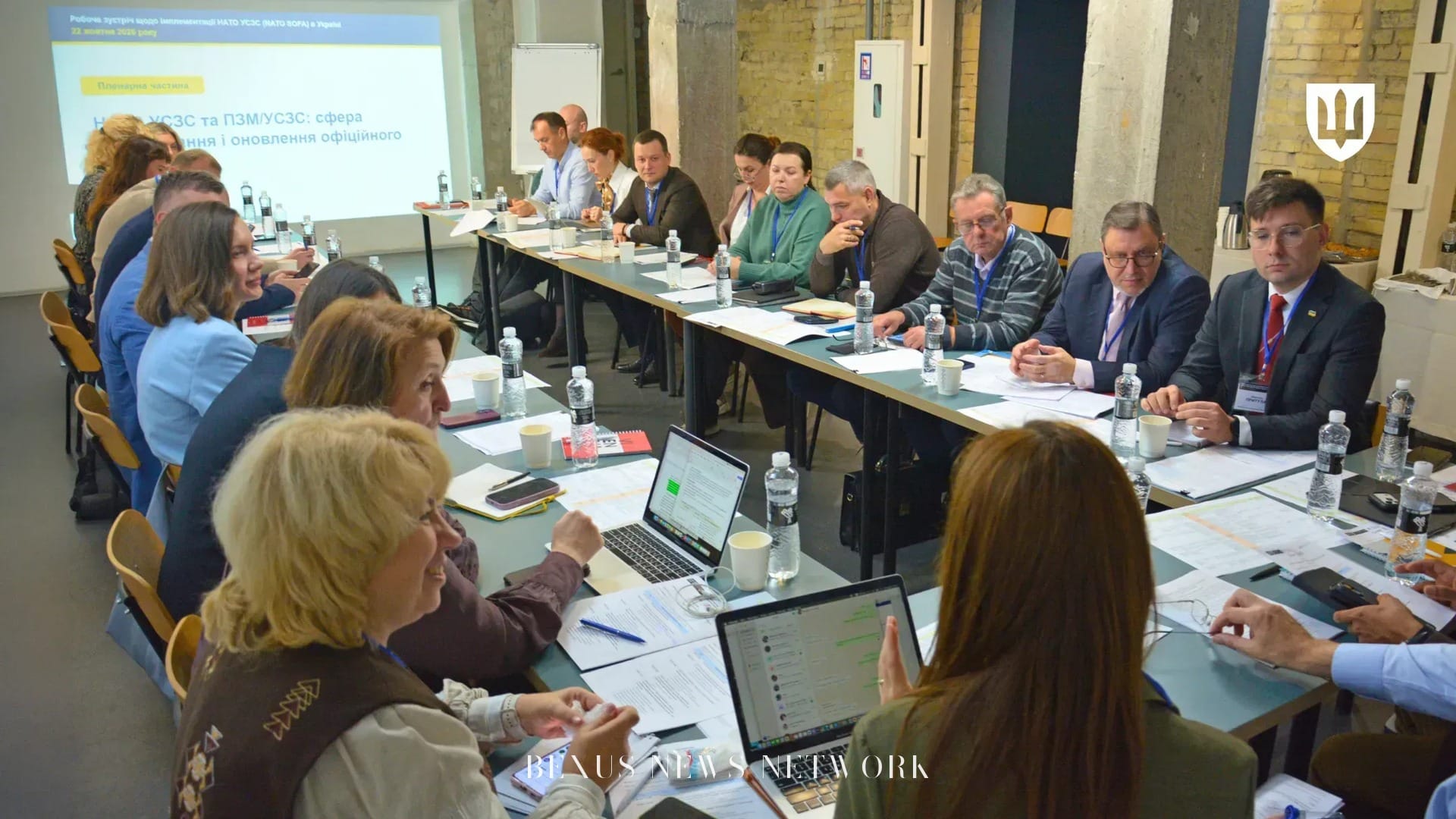
The Ministry of Defence of Ukraine announced that it held a working meeting on October 27, 2026, to incorporate the NATO Status of Forces Agreement (NATO SOFA) into Ukrainian law. A status of forces agreement defines the legal status of a country's military forces and personnel when staying in the territory of another country. The Ministry of Defence announced that the meeting participants identified issues arising from the application of the agreement, agreed on directions for solutions, and specifically determined areas where Ukrainian legislation needs further amendments regarding criminal jurisdiction and the processing of damage claims. The Ministry of Defence announced that properly implementing the provisions of this agreement is particularly vital amid discussions on security guarantees for Ukraine. On October 28, the Ministry of Defence wrote on its official X account that "Security guarantees need legal groundwork."
Security guarantees need legal groundwork. The Ministry of Defence is working to bring the NATO Status of Forces Agreement into Ukrainian law.
— Defense of Ukraine (@DefenceU) 2026년 10월 28일
At a working meeting held with the Ukrainian Helsinki Human Rights Union, representatives of 18 state institutions reviewed a draft…
Ministry of Defence of Ukraine Holds NATO SOFA Implementation Working Meeting with 18 State Institutions
According to the Ministry of Defence, the meeting was held in cooperation with the Ukrainian Helsinki Human Rights Union. The Ukrainian Helsinki Human Rights Union is an association of human rights organizations in Ukraine. The Ministry of Defence announced that the meeting's discussions were based on a draft "Implementation Plan" jointly developed by the Ministry of Defence and the Ukrainian Helsinki Human Rights Union. According to the Ministry of Defence, this draft contains measures to close gaps in implementing the agreement's provisions and designates the institutions responsible for each measure.
The Ministry of Defence announced that representatives from 18 state institutions, including ministries, law enforcement agencies, the General Staff of the Armed Forces of Ukraine, and the National Bank of Ukraine, attended the meeting. The Ministry of Defence stated that attendance was twice what was expected, demonstrating the timeliness of incorporating the agreement into national law. According to the Ministry of Defence, the meeting was supported by the United Kingdom's Special Defence Advisor Programme.
The Ministry of Defence announced that the meeting focused on the practical application of the agreement's provisions and the necessary legislative amendments. According to the Ministry of Defence, representatives of the Prosecutor General's Office of Ukraine and the Ministry of Justice shared their experiences in applying criminal jurisdiction provisions, and participants also reviewed the possibility of amending the Criminal Procedure Code of Ukraine. Participants also discussed procedures for reviewing damage claims and compensation, as well as the current status of and improvement measures for customs regulation. The Ministry of Defence announced that tax issues arising from the application of the agreement were also a major item on the meeting's agenda.
NATO Member States Signed SOFA in London in 1951, Defining the Legal Status of Visiting Forces
According to NATO, the NATO SOFA was drawn up in London on June 19, 1951, in English and French, with both language texts being equally authentic. The preamble of the agreement states that it defines the status of forces, taking into account that the forces of one contracting party may be sent, by arrangement, to serve in the territory of another contracting party. The agreement refers to the country sending the forces as the "sending State" and the country receiving them as the "receiving State." Article II of the agreement stipulates that the visiting force, the civilian component, and their dependents must respect the laws of the receiving State and abstain from any political activity in the receiving State, and that the sending State must take the necessary measures to this end. The civilian component refers to civilian personnel employed by the armed service of a sending State who accompany that force. Article I of the agreement excludes from the civilian component stateless persons, nationals of any State that is not a party to the North Atlantic Treaty, and nationals of, or ordinarily resident in, the receiving State, and defines dependents as the spouse and dependent children of a member of a force or civilian component.
Article III of the agreement stipulates that members of a visiting force are exempt from passport and visa regulations and immigration inspection when entering or leaving the receiving State, but do not acquire any right to permanent residence or domicile in the receiving State. Under Article III, members of a visiting force must present on demand a sending State identity card showing their name, date of birth, rank, and photograph, as well as an individual or collective movement order in the language of the sending State, English, and French. Article IV stipulates that the receiving State may either accept a driving permit issued by the sending State without a driving test or fee, or issue its own driving license without a test. Article VI of the agreement stipulates that members of a visiting force may possess and carry arms when authorized to do so by their orders. Article V of the agreement stipulates that units of a visiting force must be in uniform when crossing frontiers, and that official vehicles of a visiting force must carry nationality markings in addition to registration numbers. Article IX of the agreement stipulates that a visiting force, its civilian component, and dependents may purchase goods and services locally for their own consumption on the same terms as nationals of the receiving State, and requires the authorities of the receiving State to designate, where necessary, articles whose purchase should be restricted or prohibited so as not to adversely affect the economy of the receiving State. Article IX places the responsibility on the authorities of the receiving State to make arrangements for the provision of buildings, grounds, and related facilities and services needed by the visiting force.
Article VII, the core of the agreement, deals with criminal jurisdiction. Criminal jurisdiction is the authority to investigate and try offenses. Under Article VII, the military authorities of the sending State may exercise within the receiving State the criminal and disciplinary jurisdiction conferred on them by the law of the sending State over all persons subject to the military law of that State, and the authorities of the receiving State have jurisdiction with respect to offenses committed within the territory of the receiving State and punishable by the law of that State. In cases where jurisdiction is concurrent, the sending State has the "primary right" to exercise jurisdiction over offenses solely against the property or security of that State, offenses solely against the person or property of another member of the force or civilian component or of a dependent, and offenses arising out of any act or omission done in the performance of official duty. In the case of any other offense, the receiving State has the primary right to exercise jurisdiction. Article VII provides that where an offense is punishable by the law of only one State, that State has exclusive jurisdiction, citing as offenses against national security treason, sabotage, espionage, and violations of official secrets or defense secrets laws. The agreement provides that if the State having the primary right decides not to exercise jurisdiction, it shall notify the authorities of the other State as soon as practicable, and shall give sympathetic consideration to a request from the other State for a waiver of its right. Article VII requires the authorities of the receiving and sending States to assist each other in the arrest of members of a visiting force in the territory of the receiving State and in handing them over to the authority which is to exercise jurisdiction, and requires the receiving State to notify the military authorities of the sending State promptly when it arrests a member of a visiting force. If a suspect over whom the receiving State is to exercise jurisdiction is in the custody of the sending State, the sending State retains custody until that person is charged by the receiving State. The two States must also assist each other in conducting investigations and collecting evidence. Article VII stipulates that a death sentence cannot be carried out in the receiving State by the authorities of the sending State if the law of the receiving State does not provide for the death penalty in a similar case, and prohibits a person who has been tried by one contracting party and acquitted or convicted from being tried again for the same offense by another contracting party.
NATO SOFA Provisions Apply to Ukraine Through Partnership for Peace SOFA
According to the Ministry of Defence of Ukraine, the provisions of the NATO SOFA apply to Ukraine through the Partnership for Peace Status of Forces Agreement (PfP SOFA). The Partnership for Peace (PfP) is a framework established by NATO to cooperate with non-member states. According to NATO, the PfP SOFA was concluded on June 19, 1995. The preamble of the agreement states that the Heads of State and Government of the member States of NATO invited participation in the PfP in Brussels on January 10, 1994. Article I of the PfP SOFA stipulates that all contracting parties shall apply the provisions of the NATO SOFA as if they were parties to the NATO SOFA. Article II provides that the agreement also applies to the territory of PfP SOFA parties that are not parties to the NATO SOFA. Under Article III, in matters involving non-parties to the NATO SOFA, instead of the NATO SOFA provisions referring disputes to the North Atlantic Council or an arbitrator, the parties concerned must negotiate among themselves without outside jurisdiction.
The Ministry of Defence highlighted the revised official Ukrainian translation of the agreement as a major achievement of the implementation work to date. According to the Ministry of Defence, the revised translation was published on the official web portal of the Verkhovna Rada (parliament) of Ukraine. The Ministry of Defence announced that this translation was developed at the initiative and with the direct participation of the Ministry of Defence, in cooperation with relevant agencies including the Ministry of Foreign Affairs, the Ministry of Justice, the Prosecutor General's Office, and the Ministry of Internal Affairs.
Ukrainian President Volodymyr Zelenskyy wrote on his official X account on October 25 that "Our security guarantees are our security guarantees. They cannot be dictated by the Russian side." President Zelenskyy stated, "Restrictions on our army and Ukraine's neutrality are not up for discussion," adding that the territorial issue should be discussed at the leader level, while other issues should be discussed at the technical group level, and all of this can be discussed in November.
Our security guarantees are our security guarantees. They cannot be dictated by the Russian side. Restrictions on our army and Ukraine’s neutrality are not up for discussion. The territorial issue is a red line that can only be discussed at the level of leaders. The Americans…
— Volodymyr Zelenskyy / Володимир Зеленський (@ZelenskyyUa) 2026년 10월 25일
Ministry of Defence Also Decides to Align Claims, Customs, and Taxation with Agreement
Claims for damages, which was on the agenda for the meeting, is governed by Article VIII of the NATO SOFA. Under Article VIII, each contracting party waives all its claims against any other contracting party for damage to any property owned by it and used by its armed forces, if such damage was caused by a member of the armed forces of the other contracting party in connection with the operation of the North Atlantic Treaty. Each contracting party also waives all its claims against any other contracting party for injury or death suffered by any member of its armed forces while engaged in the performance of official duties. Article VIII also provides for the waiver of maritime salvage claims between contracting parties if the vessel or cargo salvaged was the property of another contracting party and used in connection with the operation of the North Atlantic Treaty. When a visiting force causes damage to a third party within the receiving State in the performance of official duty, the claim is handled by the receiving State in accordance with its laws and regulations applicable to claims arising from the activities of its own armed forces, and paid in the currency of the receiving State. Claims arising out of acts or omissions not done in the performance of official duty are fairly assessed by the authorities of the receiving State, which estimates compensation and submits a report to the authorities of the sending State, which shall then decide without delay whether it will make an "ex gratia" payment and in what amount. The agreement provides that where the sending State alone is responsible, the amount of compensation is apportioned 25 percent to the receiving State and 75 percent to the sending State.
Taxation is covered by Article X, and customs by Article XI. Under Article X, periods during which members of a visiting force and civilian component are in the receiving State solely by reason of that status are not considered periods of residence for receiving State taxation purposes, and salaries paid to them by the sending State are exempt from receiving State taxation. Article XI stipulates that, except as otherwise provided in the agreement, members of a visiting force, the civilian component, and their dependents are subject to the customs laws and regulations of the receiving State, and customs authorities of the receiving State may inspect their persons, baggage, and vehicles and seize goods in accordance with the law. Article XII provides that the customs and fiscal authorities of the receiving State may impose conditions to prevent abuses in granting exemptions under the agreement, and Article XIII requires the authorities of the receiving and sending States to assist each other in investigations and the collection of evidence to prevent offenses against customs and fiscal regulations. Article XI permits the temporary importation and re-exportation of official vehicles of a visiting force free of duty when entering and leaving under their own power upon presentation of customs documents.
Article XVI of the agreement provides that differences between contracting parties relating to the interpretation or application of the agreement shall be settled by negotiation without outside jurisdiction, and disputes that cannot be settled by direct negotiation shall be referred to the North Atlantic Council. Under Article XVII, any contracting party may at any time request the North Atlantic Council to revise any article. Article XVIII provides that the agreement enters into force among signatory States 30 days after four signatory States have deposited their instruments of ratification with the United States, and that States subsequently acceding to NATO may accede to the agreement upon approval by the North Atlantic Council. Article XIX provides that after the expiration of four years from the date on which the agreement comes into force, any contracting party may denounce the agreement by written notification to the United States, with denunciation taking effect one year after receipt of the notification.
The Ministry of Defence announced that following the meeting, participants agreed to hold further consultations based on the developed proposals. The Ministry of Defence stated that it will continue consistently with work to incorporate the agreement's provisions into national law. On its official X account, the Ministry of Defence noted that the draft implementation plan addresses criminal jurisdiction, claims, customs, and taxes, stating that "Further consultations will follow."
Sources (KST)
- Ministry of Defence of Ukraine, "Ukraine's Ministry of Defence works to implement the NATO Status of Forces Agreement" (October 27, 2026): https://mod.gov.ua/en/news/nato-sofa-implementation-in-ukraine
- NATO, "Agreement between the Parties to the North Atlantic Treaty regarding the Status of their Forces" (June 19, 1951): https://www.nato.int/cps/en/natohq/official_texts_17265.htm
- NATO, "Agreement among the States Parties to the North Atlantic Treaty and the other States participating in the Partnership for Peace regarding the Status of their Forces" (June 19, 1995): https://www.nato.int/cps/en/natohq/official_texts_24742.htm
- Ministry of Defence of Ukraine X Post (October 28, 2026): https://x.com/DefenceU/status/2115392632293826562
- Ukrainian President Volodymyr Zelenskyy X Post (October 25, 2026): https://x.com/ZelenskyyUa/status/2114429570686619763