U.S. National Counterintelligence and Security Center: "Chinese Government Conducts Influence Operations Targeting U.S. State and Local Governments and Business Leaders Through Investment, Exchanges, and Cyber"
WASHINGTON, U.S.
The U.S. National Counterintelligence and Security Center (NCSC) announced that the Chinese government is leveraging relationships with U.S. state and local government officials and business leaders to influence U.S. policies and expand its strategic interests. Warning that seemingly mutually beneficial commercial opportunities or cultural exchanges can mask political motives, the NCSC advised implementing rigorous vetting and transparent agreements when partnering with foreign entities.
U.S. Counterintelligence Officials: "Local Leaders Could Be Exploited in Operations Unwittingly"
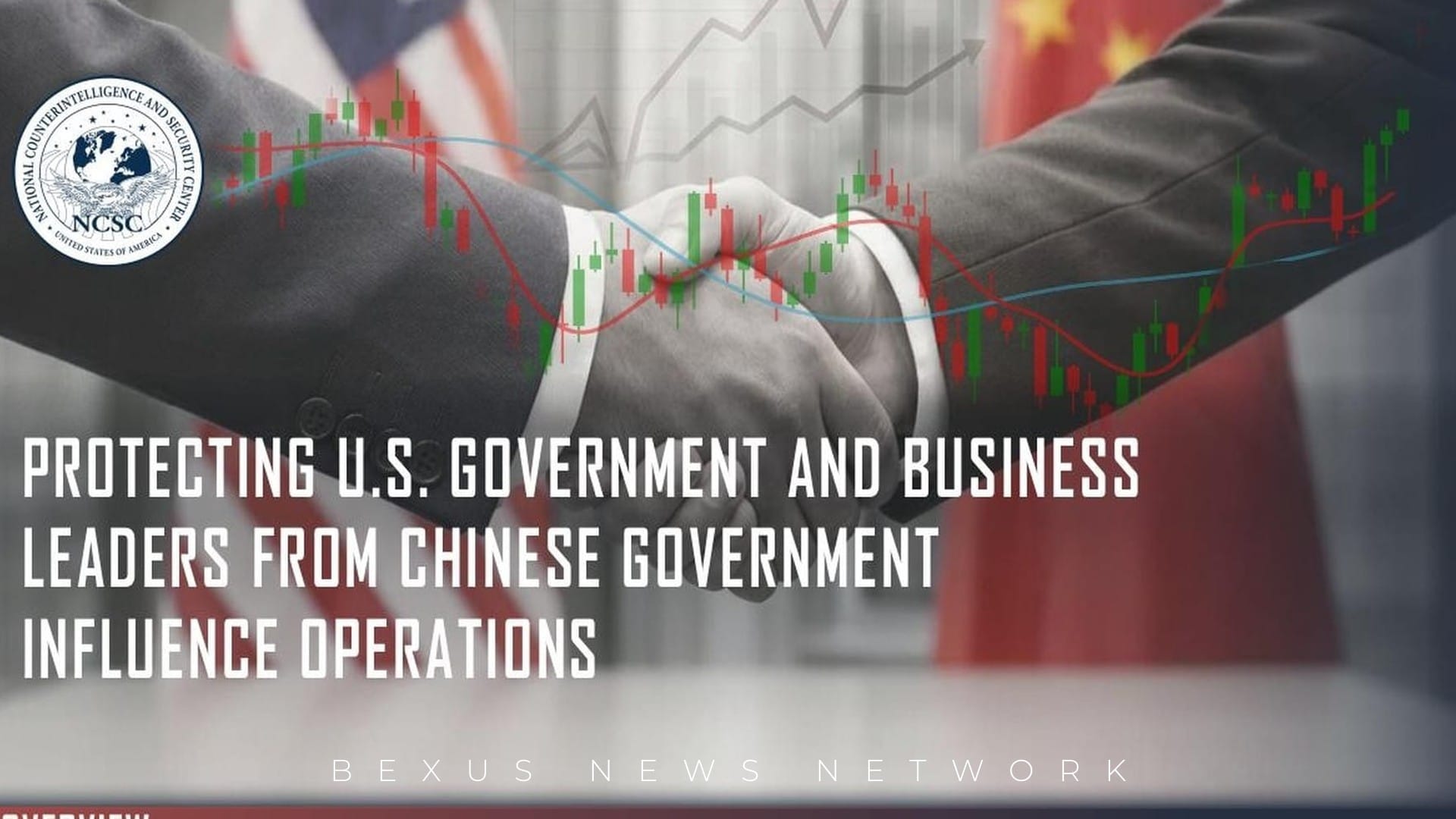
The NCSC, an agency under the Office of the Director of National Intelligence (ODNI), highlighted the threat by posting "Protecting U.S. Government and Business Leaders from Chinese Government Influence Operations" to its resources library on the afternoon of October 28 (EDT). The publication date marked at the bottom of the document is August 2026. On the same day, the NCSC also published materials on protecting financial institution data and countering infrastructure sabotage.
The NCSC stated that for decades, various Chinese entities have cultivated ties with U.S. state and local officials and business leaders, with many of these connections offering legitimate commercial, cultural, and educational benefits to both sides. However, the agency added that amid heightened tensions between the U.S. and China, the Chinese government—guided by the Chinese Communist Party (CCP) and its United Front Work Department (UFWD)—is increasingly exploiting these relationships to sway U.S. policy.
U.S. Counterintelligence Officials Say Public Diplomacy and Covert Methods Are Intertwined
According to the NCSC, China's local-level engagement blends public diplomacy with covert and coercive tactics. As a result of sophisticated and deceptive influence operations, U.S. leaders at the state, local, tribal, and territorial levels could unwittingly advance the CCP's agenda.
The NCSC stated that China employs proxy organizations, including front companies and non-governmental organizations, to obscure the true nature of its engagements and maintain operational secrecy and plausible deniability. Advances in technology and social media have expanded the reach of these operations, making detection more difficult, the agency explained. It also noted that China may pressure U.S. companies to lobby officials at all levels of government to support China-friendly policies or oppose measures perceived as threats by the CCP.
The agency stated that the UFWD coordinates with other Chinese government agencies to conduct global influence campaigns through multiple front organizations. Key actors identified by the NCSC include the Chinese People's Association for Friendship with Foreign Countries (CPAFFC) and the China Council for the Promotion of Peaceful National Reunification (CCPPNR).
Collecting Leaders' Personal Information to Select Targets
The NCSC reported that China systematically harvests and analyzes data—including personally identifiable information—on U.S. state and local leaders, business executives, and their associates to select targets for influence operations. Methods include social media, commercial databases, technological tools, and artificial intelligence models such as DeepSeek, which is owned by a Chinese firm. The NCSC explained that China builds detailed dossiers on individuals of interest to discern their viewpoints and identify vulnerabilities, which are subsequently exploited in influence campaigns or retained as future leverage.
The NCSC also revealed that China conducts diverse cyber operations designed to set the stage for targeting public and private information networks, establishing footholds within critical U.S. infrastructure systems for future exploitation. These operations range from broad-based network intrusions to targeted breaches aimed at critics of China and political figures, according to the NCSC.
As an example, the NCSC cited the March 2024 indictment of seven hackers linked to the Chinese government. According to the U.S. Department of Justice, they are accused of conducting computer intrusions spanning approximately 14 years targeting critics of China, businesses, and politicians in the United States and abroad. The Justice Department stated that the defendants were members of a hacking group known as 'APT31' and sent more than 10,000 malicious emails to compromise email accounts, personal devices, and networks.
Seven Hackers Associated with Chinese Government Charged with Computer Intrusions Targeting Perceived Critics of China and U.S. Businesses and Politicians @NewYorkFBI @FBIChicagohttps://t.co/ePNuXOfNVB pic.twitter.com/8BcGZ7D6Bi
— FBI (@FBI) 2024년 3월 25일
The Federal Bureau of Investigation (FBI) announced the indictments on its official X account at the time.
According to the U.S. Department of Justice, targets included White House personnel, officials from multiple federal departments, U.S. senators and representatives along with their staffers, democracy advocates, and defense contractors across several nations. The seven individuals were charged with conspiracy to commit computer intrusions and conspiracy to commit wire fraud. The Justice Department emphasized that an indictment is merely an allegation and defendants are presumed innocent until proven guilty.
Today, #FBINewYork along with @FBIChicago and @EDNYNews charged seven hackers associated with the Chinese Government for computer intrusions targeting perceived critics of China and U.S. businesses and politicianshttps://t.co/D8KbqNqVDA pic.twitter.com/Lg3HKlC0v7
— FBI New York (@NewYorkFBI) 2024년 3월 25일
The FBI New York Field Office also posted on X the same day that it had charged the seven individuals in coordination with the Chicago Field Office and the U.S. Attorney's Office for the Eastern District of New York.
Cultivating Future Persons of Influence Early On
The NCSC stated that China establishes relationships with U.S. counterparts early in their careers and seeks to capitalize on those ties once the individuals ascend to positions of influence. Investigative findings demonstrate that figures embedded within state and local governments can effectively advocate for pro-China policies after gaining substantial authority, the agency explained.
As an example, the NCSC cited the September 2024 indictment of a former staffer to high-ranking New York State officials on charges of violating and conspiring to violate the Foreign Agents Registration Act. According to the NCSC, the staffer allegedly used her official position to advance Chinese interests by blocking representatives of the Taiwanese government from meeting high-ranking New York State officials and modifying the officials' messaging regarding China and the CCP. The NCSC document did not address the subsequent judicial proceedings in the case.
The NCSC reported that China frequently leverages "people-to-people diplomacy" via the UFWD and the CPAFFC, pursuing political objectives through non-state channels and subnational relationships such as cultural exchanges, economic partnerships, and sister-city agreements. The agency warned that although such commercial, technological, cultural, and educational exchanges may appear friendly and advantageous, they can be strategically utilized to serve CCP interests.
Economic Dependence, Media, and Online Public Opinion Serve as Levers
The NCSC pointed out that China or its proxies can foster economic dependence among local business and government leaders through financial incentives, investments, and market access leverage. While economic relationships are frequently framed as mutually beneficial, they can create dynamics in which U.S. public officials and business leaders feel pressured to lobby for policies favorable to China or oppose measures disfavored by Beijing, the agency explained.
As an illustrative case, the NCSC cited the 40th anniversary celebration of the American Fujian Houyu Association held in Flushing, Queens, New York, on April 28, 2024. According to the agency, 53 China-affiliated organizations convened at the event, some of which are known to promote Chinese interests, maintain ties with CCP officials, or engage in extensive interaction with the Chinese Consulate. Citing Chinese media coverage of the gathering, the NCSC noted reports that participating groups endorsed and raised campaign funds for several political candidates in New York.
The NCSC also highlighted that China utilizes state-run media and China-linked community organizations to construct favorable narratives, shape local public opinion, and exert pressure on critics within the United States. Methods include coordinated online influence campaigns utilizing inauthentic accounts, amplification of favored narratives, manipulation of digital conversations on sensitive topics such as Chinese human rights abuses, U.S.-Taiwan relations, and U.S. politics, as well as placing sponsored content, the agency explained. The NCSC added that these operations encompass transnational repression tactics that use harassment, intimidation, and coercion to silence diaspora communities and Chinese nationals critical of the CCP.
The NCSC also pointed to a January 2020 incident in which the Chinese Consul General in Chicago publicly criticized Taiwan's position after the Taipei Economic and Cultural Office in Chicago submitted a letter to the Chicago Tribune addressing Taiwan's representation in the World Health Organization. The agency further cautioned that academic research partnerships, Confucius Institute-style programs, student and scholar exchanges, and university donation arrangements can pose substantial risks to intellectual property and national security absent adequate safeguards and transparency.
U.S. Counterintelligence Recommends Vetting and Transparency as Countermeasures
The NCSC urged stakeholders to recognize that foreign partnerships often come with trade-offs and to pursue engagements guided by clear objectives aligned with U.S. national interests. By adhering to transparency, reciprocity, and accountability, U.S. public officials and business leaders can safeguard against exploitation while preserving the benefits of engaging with foreign entities, including those from China, the agency stated. It recommended adopting or strengthening ethics codes requiring public reporting of foreign-funded travel and gifts, as well as barring undisclosed commitments.
The NCSC recommended conducting due diligence on prospective partners and investors prior to establishing relationships or approving incentives and sales. Suggested resources include the U.S. Department of Commerce's Consolidated Screening List and the U.S. Department of Justice's Foreign Agents Registration Act (FARA) database. The agency also proposed requiring disclosure of ownership structures for land acquisitions and infrastructure transactions, as well as obtaining and publishing full participant lists, sponsors, and meeting agendas before hosting visiting delegations. It further advised confirming the legal status and beneficial ownership of corporations or foundations offering investment or research funding.
The NCSC advised making contracts and partnership agreements with foreign entities public, ensuring they feature mutually agreed-upon objectives alongside explicit termination and governing law provisions. Legal reviews should evaluate implications for intellectual property, data sharing, publication rights, and export controls, and entities should refuse clauses that restrict future lawful agreements or freedom of expression. For universities and research institutions, the agency urged reviewing R&D contracts to safeguard intellectual property, preserve publication rights, manage access to controlled technologies, and ensure export control compliance, while utilizing internal compliance offices and federal guidelines for sensitive research. It also called for vigilance against transnational repression targeting diaspora communities and international students, advocating policies that counter tangible threats while upholding free expression.
The NCSC recommended organizing workshops and briefings to help local officials understand Chinese government influence operations, emphasizing that awareness is essential for informed decision-making. When meeting with Chinese government representatives, officials were advised to reaffirm U.S. commitments to democratic principles and human rights, ensuring discussions incorporate foundational values underpinning U.S. policy in addition to economic cooperation.
The NCSC advised maintaining communication channels with local FBI field offices, the Department of Homeland Security Office of Intelligence and Analysis, state fusion centers, and the Cybersecurity and Infrastructure Security Agency (CISA), and promptly reporting suspicious activities. Covert influence efforts, criminal approaches, and insider threats should be reported to local FBI field offices, while cyber incidents or network intrusions should be reported immediately to CISA and state chief information security officers or fusion centers. State and local government bodies can request regional threat intelligence and unclassified briefings via state fusion centers or the DHS Office of Intelligence and Analysis. The document also listed reporting contacts for the Army Counterintelligence Command and the Naval Criminal Investigative Service under the Department of Defense.
Emphasizing that it is critical for U.S. leaders to understand China's subnational influence operations, the NCSC concluded that exercising diligence and implementing proactive response strategies will enable stakeholders to mitigate risks, preserve independence in decision-making, and remain aligned with national priorities. Operating under the Director of National Intelligence, the NCSC leads counterintelligence for the U.S. government and consistently publishes resources to inform the private sector and local governments of counterintelligence threats.
Sources (KST)
- National Counterintelligence and Security Center (NCSC), "Protecting U.S. Government and Business Leaders from Chinese Government Influence Operations" (document marked August 2026, posted to resource library October 28, 2026 at 15:33 EDT): https://www.odni.gov/wp-content/uploads/dlm_uploads/10-14-26_Safeguarding_PRC_Influence_FINAL_APPROVED.pdf
- ODNI NCSC Resources Library: https://www.odni.gov/about/mission-centers-directorates/ncsc/resources/
- U.S. Department of Justice, "Seven Hackers Associated with Chinese Government Charged with Computer Intrusions Targeting Perceived Critics of China and U.S. Businesses and Politicians" (March 25, 2024): https://www.justice.gov/opa/pr/seven-hackers-associated-chinese-government-charged-computer-intrusions-targeting-perceived
- FBI Official X Account (@FBI): https://x.com/FBI/status/1772315065837846561
- FBI New York Field Office Official X Account (@NewYorkFBI): https://x.com/NewYorkFBI/status/1772301932880667079