Liaoning Carrier Group Passes Through the Miyako Strait, Across the Pacific, and Toward the South China Sea…Taiwan's Ministry of National Defense Monitoring the Possibility of Large-Scale Exercises in November–December
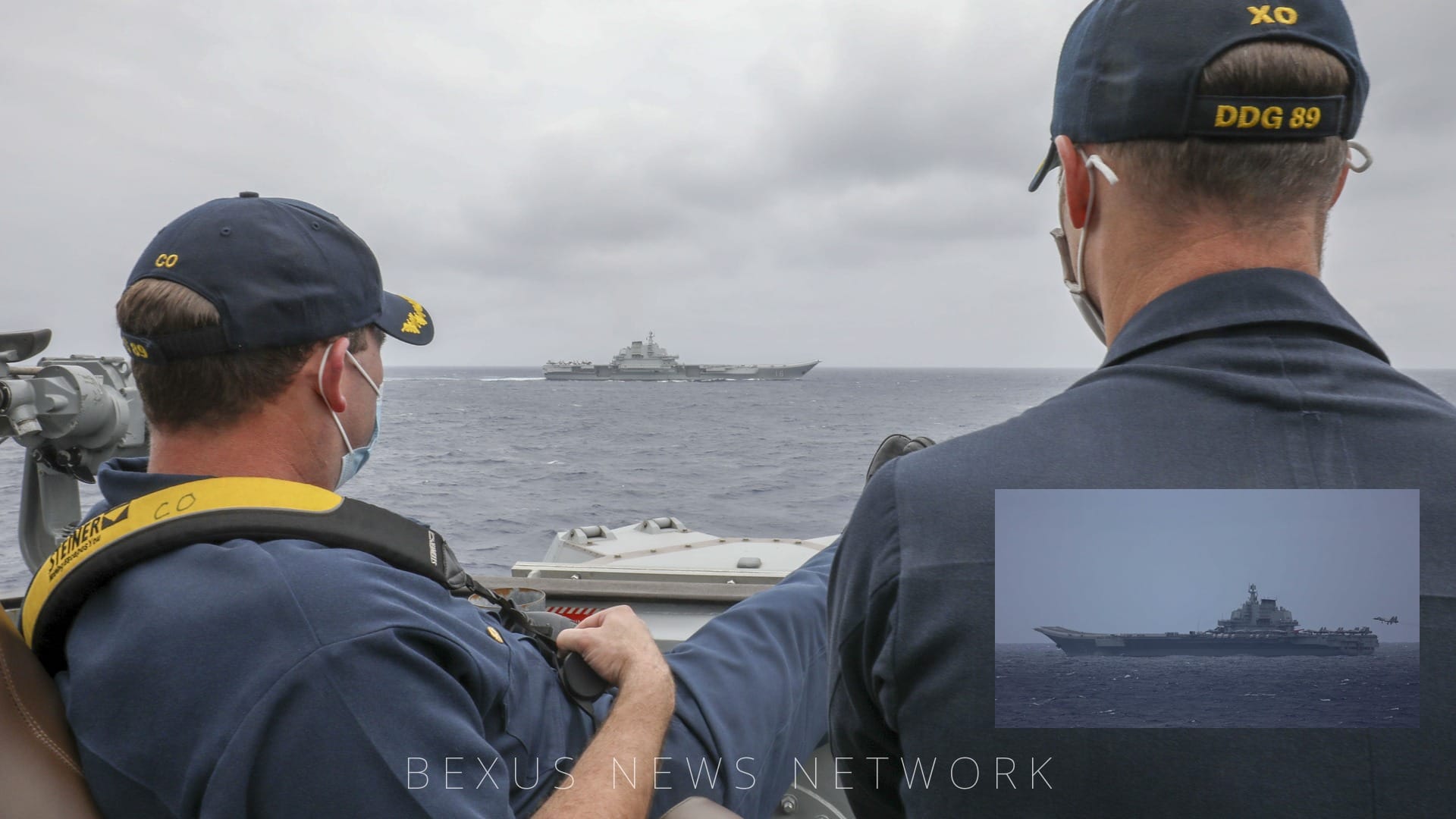
Four vessels, including the Chinese Navy aircraft carrier Liaoning, passed through the waters between Okinawa's main island and Miyako Island on October 14 into the Pacific, and headed toward the South China Sea just one day later, on the 15th, Japan's Ministry of Defense Joint Staff announced. The same day, Taiwan's Ministry of National Defense announced a "joint combat readiness patrol" by China's People's Liberation Army. Taiwan's Deputy Chief of the General Staff for intelligence said the possibility of large-scale exercises is being monitored ahead of the November–December exercise peak season.
What Happened
According to Japan's Joint Staff, on October 14 four vessels — the Liaoning, two Renhai-class missile destroyers, and one Luyang III-class missile destroyer — passed southeast between Okinawa's main island and Miyako Island toward the Pacific. The Joint Staff said it confirmed about 10 takeoffs and landings by the Liaoning's carrier aircraft in the Pacific the same day, and that on the 15th the four vessels moved toward the South China Sea. The waters between Okinawa and Miyako are a waterway open to international navigation, and this transit was not an entry into Japanese territorial waters.
https://x.com/jointstaffpa/status/2110317371932205415
https://x.com/jointstaffpa/status/2110662738573992119
The Chinese Navy said this exercise is "part of the annual routine exercise plan" and "does not target any specific country or objective," the Taipei Times conveyed. Because the original Chinese Navy announcement was not obtained, this explanation is conveyed with attribution to media reporting, and the reason for heading south just one day after entering the western Pacific has not been disclosed.
Taiwan Ministry of National Defense Tally
Taiwan's Ministry of National Defense said it had detected, from 9:30 a.m. on the 14th (Taiwan time), 13 Chinese military aircraft, including J-16, J-11, Su-30, JH-7, and Y-8 electronic warfare aircraft. Of these, Taiwan's Ministry of National Defense explained, 11 crossed the median line of the Taiwan Strait and entered the northern, central, and southwestern Air Defense Identification Zone (ADIZ) of Taiwan and conducted a "joint combat readiness patrol".
https://x.com/MoNDefense/status/2110226591586701545
The daily tallies also continued. According to Taiwan's Ministry of National Defense, in the 24 hours up to 6 a.m. on the 15th, 15 military aircraft, 10 naval vessels, and 7 official vessels were detected, and 13 military aircraft crossed the median line. Up to 6 a.m. on the 16th, there were 8 military aircraft, 9 naval vessels, and 7 official vessels, and all 8 crossed the median line and entered the northern and southwestern ADIZ. An ADIZ is a zone each country sets for early identification and is not airspace. Therefore, these figures are not an "airspace intrusion" but an "ADIZ entry."
https://x.com/MoNDefense/status/2110536140809719853
According to the Taipei Times, Pan Jiunn-guang, Taiwan's Deputy Chief of the General Staff for intelligence, answered at a press conference on the 15th, when asked about the possibility of large-scale exercises around Taiwan ahead of the People's Liberation Army's November–December exercise peak season, that trends are being monitored with joint intelligence, surveillance, and reconnaissance (ISR) capabilities. He also said the Liaoning group's activity had raised concerns among countries in the region. Because the original text and transcript of Taiwan's Ministry of National Defense press conference were not obtained, the exact wording of the remarks is limited to the Taipei Times report. The passage in the same report conveying that "there has been no large-scale encirclement-type exercise around Taiwan this year" also could not be separately confirmed against an official exercise list of Taiwan's Ministry of National Defense.
Taiwan's Ministry of National Defense said of this patrol that it "strictly monitored and responded with mission aircraft and vessels and ground-deployed missile systems." No actual interception or engagement was announced. Looking at the daily tallies by date, as of 6 a.m. they were: on the 13th, 5 military aircraft (4 crossing the median line); on the 14th, 9 (9); on the 15th, 15 (13); and on the 16th, 8 (8). By numbers alone, they increased around the 14th, when there was a patrol, and then decreased again. But naval vessels increased from 6 to 9–10, and official vessels also increased from 4 to 7, so activity on the maritime side did not decrease. Official vessels is Taiwan's Ministry of National Defense classification meaning non-military government vessels such as the coast guard.
The Diplomatic Front
In the same week, Taiwan's Ministry of Foreign Affairs welcomed that the European Parliament had reaffirmed that "the EU has never supported the 'One China principle'" and rejected China's interpretation of UN General Assembly resolution 2758 as a "distortion". The "One China principle" is the position of the Chinese government. It is a different concept from the "One China policy" used by the United States and European countries.
Why It Matters
This movement matters because the carrier group moved through the Nansei Islands waterway and the western Pacific and, in just one day, moved to the South China Sea. However, the exact track within the South China Sea has not been confirmed because there has been no next announcement from the Japanese and Taiwanese authorities. The precedent is the exercises the People's Liberation Army conducted around Taiwan immediately after the August 2022 visit to Taiwan by then-U.S. House Speaker Nancy Pelosi. Japan's Ministry of Defense announced that on August 4 China appeared to have fired 9 ballistic missiles, of which 5 fell inside Japan's exclusive economic zone (EEZ) southwest of Hateruma Island, and 4 were presumed to have passed over Taiwan's main island. The same day, Taiwan's Ministry of National Defense said 11 Dongfeng-series ballistic missiles had been launched, so the two sides' tallies differed. Because the original 2022 press release of Taiwan's Ministry of National Defense was not obtained, the figure of 11 is limited to the Ministry of National Defense announcement conveyed by Taiwan News. Then-Japanese Defense Minister Nobuo Kishi said at the time that it was the first time Chinese missiles had fallen in Japan's EEZ. Because this remark was confirmed through Japan Times and Reuters reporting and not the Ministry of Defense press conference original, the minister's exact expression requires confirmation of the original text. This Liaoning group also passed through the same Nansei Islands area.
Next Steps
The Liaoning group's next movement in the South China Sea must be confirmed through the daily announcements of Japan's Joint Staff and Taiwan's Ministry of National Defense. China's Maritime Safety Administration issued exercise navigation warnings for five sea areas — the Bohai Sea, the northern Yellow Sea, the southern Yellow Sea (Korean name: West Sea), the East China Sea, and the South China Sea — and among these, the southern Yellow Sea area is scheduled to end at 6 p.m. on the 17th (China time). Waters around Taiwan are not included in the warning areas. The U.S.–Japan joint exercise Keen Sword is scheduled to begin on October 19. The Keen Sword schedule was confirmed through a Japanese local government posting and USNI reporting, and the original joint announcement by the U.S. military and the Self-Defense Forces was not obtained. Taiwan's Ministry of National Defense announces, at around 9 a.m. (Taiwan time) every day, the tally as of 6 a.m. the previous day, and the next announcement is the morning tally of October 17.
Background: The Frequency of the Liaoning's Pacific Entries and the Scale of Takeoffs and Landings
The carrier activity materials accumulated and disclosed by Japan's Ministry of Defense are as follows. According to the Chinese naval activity summary materials posted by the Ministry of Defense, the Ministry of Defense said the Liaoning's entries into the Pacific have been confirmed 13 times since 2016, and the Shandong's entries into the Pacific have been confirmed 9 times since 2023. The Ministry of Defense conveyed that the same materials listed as the Liaoning's entry points December 2016, April 2018, June 2019, April 2020, April 2021, December 2021, May 2022, December 2022, and September 2024. The Ministry of Defense's cumulative tally shows that the carrier's own entries have been an annual observation subject. However, this count is on the basis of entries confirmed and announced by the Japanese side, and whether it is the same tally as the number of exercises announced by the Chinese Navy could not be compared because a cumulative Chinese list was not obtained. A list of the original Chinese Navy announcements has not been made public.
There is also a case in which the route widened. According to a September 18, 2024 announcement by Japan's Joint Staff, the Joint Staff said the Liaoning and two Luyang III-class destroyers (hull numbers 120 and 123), three vessels in total, were confirmed at around 7 p.m. on September 17 in waters about 210km northwest of Uotsuri Island, and then headed south through waters about 70km west of the same island, passed through the waters between Yonaguni Island and Iriomote Island, and headed toward the Pacific. The Joint Staff said in the same announcement that it was the first time it had confirmed a Chinese aircraft carrier navigating the waters between Yonaguni and Iriomote. The announcement conveyed that the Maritime Self-Defense Force destroyers "Takanami" and "Sendai" and aircraft P-1 and P-3C were deployed for monitoring. Because this 2024 case has a different route from this Miyako Strait transit, it must not be read to mean the Miyako transit is the first, and is used only as a case showing, through official records, that the exit a carrier can use in the Nansei Islands is not only Miyako.
A reference point for the scale of takeoffs and landings is as follows. According to a June 5, 2025 announcement by the Joint Staff, the Maritime Self-Defense Force confirmed about 140 takeoffs and landings from May 27 to 29, 2025 — about 80 by the Liaoning's carrier fighters and about 60 by carrier helicopters — and the total from May 25 to 29 was about 260. In the same announcement, the Joint Staff conveyed that on May 30 vessels including the Liaoning headed south across the Pacific. Next, in a July 1, 2025 announcement, the Ministry of Defense said that on June 20 six vessels, including the Liaoning and destroyers and a replenishment ship, passed northwest between Okinawa's main island and Miyako Island into the East China Sea, and that about 150 Liaoning takeoffs and landings were confirmed in this period, making the cumulative total combined with the earlier period about 700. A simple comparison with the "about 10" in this October 2026 announcement shows a large difference in numbers, but, because the observation period, sea area, and announcement unit are not the same, it cannot be determined that activity has decreased. The 2025 figures are cumulative confirmed counts over several days, and this figure is the confirmed count the Joint Staff stated in a daily announcement, so the denominators differ.
The reason this reference point matters is that the duration of carrier aircraft operations, rather than the carrier group's transit itself, is the yardstick that divides the character of an exercise. The 2025 case shown by Japan's Ministry of Defense materials was an operation that stayed in the Pacific and accumulated hundreds of takeoffs and landings, while this announcement records a transit and a move in the direction of the South China Sea at a one-day interval, so the stay pattern is written differently. However, the number of takeoffs and landings and the length of stay after entering the South China Sea have not been confirmed because the next announcements from the Japanese and Taiwanese authorities were not obtained. Follow-up announcement documents from the two authorities have not been made public.
A late-2025 transit case is as follows. According to a December 2025 announcement by the Joint Staff, the Maritime Self-Defense Force confirmed the Liaoning and two Luyang III-class destroyers on December 10 in waters about 210km southeast of Okidaito Island and on December 11 in waters about 390km southwest of the same island, and on December 12 the Liaoning, one Renhai-class destroyer, two Luyang III-class destroyers, and one Fuyu-class replenishment ship passed northwest between Okinawa's main island and Miyako Island into the East China Sea. This case is a track that, after staying in the Pacific for several days, returned through the same waterway, and the arrangement of the dates in the announcements shows that the movement pattern differs from a track written, as in this announcement, as moving in the direction of the South China Sea in just one day. However, whether the exercise purposes of the two cases differed has not been confirmed because the original text of the Chinese Navy's explanation of purpose was not compared. The original Chinese announcement has not been made public.
Sources
Taiwan Ministry of National Defense 10/16 tally: https://www.mnd.gov.tw/en/Publication/88002 China Maritime Safety Administration navigation warning: https://www.msa.gov.cn/html/cnmsa/hxaq/article/2026/7756cc7cede54b4d9160171cc57a3ca5.html 2022.8.4 Japan Ministry of Defense announcement (9 missiles · 5 in EEZ · 4 presumed over Taiwan): https://www.mod.go.jp/j/press/news/2022/08/04d.html Taiwan Ministry of National Defense "11 missiles" — 🔶 Via Taiwan News: https://taiwannews.com.tw/en/news/4616679 Liaoning Pacific entries 13 times since 2016 · Shandong 9 times since 2023, Japan Ministry of Defense China activity summary: https://www.mod.go.jp/en/d_act/sec_env/pdf/ch_d-act_a.pdf 2024-09-17~18 first carrier transit between Yonaguni and Iriomote (3 vessels · hull numbers 120/123) Joint Staff: https://www.mod.go.jp/js/pdf/2024/p20240918_01.pdf 2025-05-25~29 takeoffs and landings about 260 (5/27~29 about 140) Joint Staff: https://www.mod.go.jp/js/pdf/2025/p20250605_01e.pdf 2025-06-20 Okinawa–Miyako northwest transit · cumulative about 700 Joint Staff: https://www.mod.go.jp/js/pdf/2025/p20250701_02e.pdf 2025-12-10~12 after Pacific stay, Okinawa–Miyako northwest transit Joint Staff: https://www.mod.go.jp/js/pdf/2025/p20251218_01e.pdf