Chinese Liaoning Carrier Task Group Transits the Miyako Strait, Trains for One Day in the Western Pacific, Then Heads to the South China Sea; 13 Sorties Enter Taiwan's ADIZ the Same Day
What Happened — Japan's Announcement
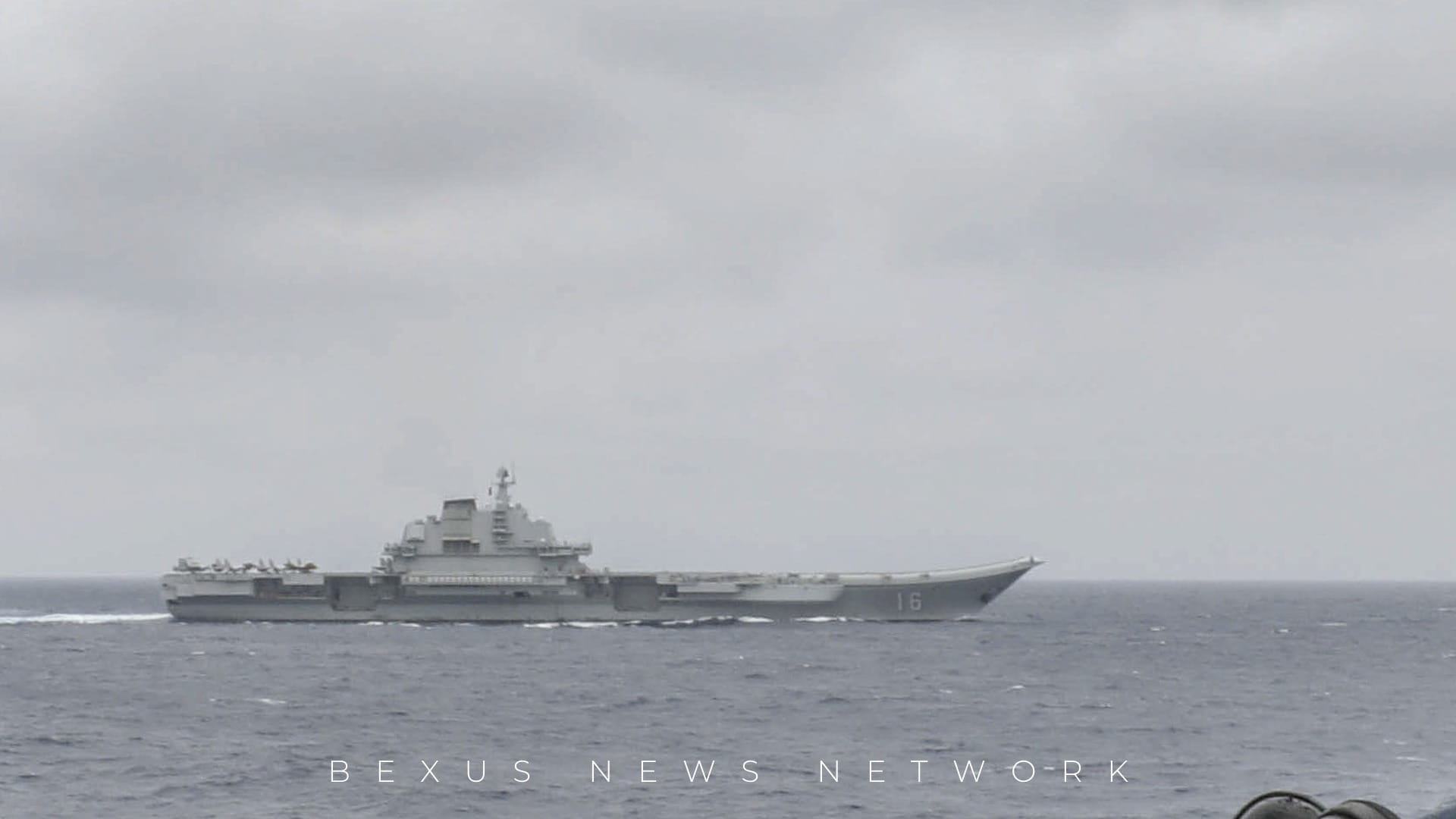
On October 14, Japan's Ministry of Defense Joint Staff announced the movements of four vessels: the Chinese Navy Kuznetsov-class aircraft carrier Liaoning (16), two Renhai-class missile destroyers (103 and 104), and one Luyang III-class missile destroyer (123). They were first confirmed at around 11 a.m. on the 13th sailing south in waters about 390km southwest of the Danjo Islands, Nagasaki Prefecture, and on the 14th passed southeast through the waters between Okinawa Island and Miyako Island (commonly called the Miyako Strait) into the Pacific. The same day, carrier-based fighter launches and recoveries were confirmed in waters about 250km south of Ishigaki Island.
Japan said the Japan Maritime Self-Defense Force destroyer Yugiri and P-1 and P-3C patrol aircraft conducted warning and surveillance, and that Air Self-Defense Force fighters were scrambled in response to the carrier aircraft launches and recoveries. Passage through these waters is navigation permitted under international law. Japan also announced this as "movements," not as a "territorial sea intrusion."
A follow-up announcement came on the 15th. It said that on the 14th, "about 10" launches and recoveries of Liaoning carrier aircraft were confirmed in the Pacific, and that on the 15th Liaoning and three destroyers, four vessels in all, sailed toward the South China Sea. https://x.com/jointstaffpa/status/2110662738573992119
The Ministry of Defense headquarters account also relayed the same content. https://x.com/ModJapan_jp/status/2110664373236621583
In summary, the stay in the western Pacific was effectively one day, and the task group moved around the east of Taiwan into the South China Sea.
China's Explanation — Claim of "Routine Training"
On the 14th, the Chinese Navy said it had "sent the Liaoning carrier task group to waters of the western Pacific to conduct training," that it was "in accordance with the annual routine training plan," "complies with relevant international law and practice," and "is not aimed at any specific country or target." This is China's explanation. The facts that the training location was inside Japan's exclusive economic zone (EEZ) and that Japan scrambled fighters must be written alongside it, based on Japan's announcement. An EEZ is not territory or a territorial sea.
Around Taiwan the Same Day — Taiwan Ministry of National Defense Announcement
Taiwan's Ministry of National Defense announced that from 6 a.m. on the 14th to 6 a.m. on the 15th (local time, 7 a.m. Korea time in each case), it detected 15 sorties of Chinese military aircraft, 10 naval vessels, and 7 government vessels around Taiwan. It said 13 of the 15 sorties crossed the Taiwan Strait median line and entered the air defense identification zones (ADIZ) of northern, central, southwestern, and eastern Taiwan. The Taiwanese military said it responded with patrol aircraft, naval vessels, and coastal missile systems. https://x.com/MoNDefense/status/2110536140809719853
Terminology must be used precisely here. An ADIZ is a zone each country establishes on its own for identification purposes and is not airspace. This is not an "airspace violation" but "median line crossings and ADIZ entries." The median line is also a concept used by Taiwan, and China's position is that it does not recognize it.
The figures fell the next day. Taiwan's Ministry of National Defense announced that from 6 a.m. on the 15th to 6 a.m. on the 16th it detected 8 aircraft sorties, 9 naval vessels, and 7 government vessels, and that all 8 sorties crossed the median line. Because these are figures from after the carrier left for the South China Sea, showing the two days together shows the flow.
Dongsha (Pratas) Water Cannon — Both Sides' Claims
Earlier this month, a Taiwan Coast Guard Administration vessel fired a water cannon at a Chinese fishing boat that did not respond to warnings in restricted waters near the Dongsha Islands. The Coast Guard Administration later said the fishing boat suffered engine failure and was towed by a nearby Chinese vessel. The Dongsha Islands are islands effectively administered by Taiwan, and China claims sovereignty over them.
At a briefing on the 14th, Chen Binhua, spokesperson for the Taiwan Affairs Office of the State Council of China, claimed that China has "indisputable sovereignty" over Dongsha and its surrounding waters and that the Taiwanese side "dangerously and roughly treated a mainland vessel and maliciously fueled cross-strait confrontation." He also said Taiwan "must bear all consequences arising from this." He did not explain what those consequences would be. The Taiwanese side's position is that it was "normal law enforcement."
The United States — MQ-9B Contractor Logistics Support Contract Notice
In a contract notice on the 15th, the U.S. Department of War (Department of Defense) said it had awarded General Atomics Aeronautical Systems a $38,766,471 contractor logistics support (CLS) contract for Taiwan MQ-9B unmanned aircraft. It is a sole-source contract under the Foreign Military Sales (FMS) program, and the work will be performed in Poway, California, through August 31, 2029. The actual contract date is October 1, and the notice is dated the 15th. It must be distinguished that this is not approval of a new weapons sale but a maintenance and support contract for aircraft already introduced.
Japan's Perspective — Keen Sword 27
The Ministry of Defense press secretary's account reported that at a press conference on the 16th, Defense Minister Koizumi received questions concerning Chinese naval movements in the Pacific and the U.S.-Japan joint integrated exercise Keen Sword 27. https://x.com/PressSec_JMOD/status/2110923362222661925
Further Developments — Task Group Composition and Surveillance Method During the 2021 Miyako Transit
Looking at past announcements by Japan's Joint Staff, one can also compare the form in which Japan has recorded Liaoning task group transits of the Miyako Strait. When Liaoning went out to the Pacific in early April 2021, the composition Japan confirmed was six vessels in all, including Liaoning, destroyers, a frigate, and a replenishment ship, and the Maritime Self-Defense Force destroyer Suzutsuki and P-1 and P-3C patrol aircraft conducted warning and surveillance. The composition announced in October 2026 was written as four vessels including the carrier, and the surveillance vessel was announced as Yugiri and the aircraft as P-1 and P-3C. The difference in vessel counts between 2021 and 2026, however, must not be immediately interpreted as an increase or decrease in task group strength. Japan's announcements are only the scope of movements confirmed, and are not statements denying vessels Japan did not detect or support assets China did not separately disclose.
In a follow-up announcement on April 27, 2021, the launch of a Chinese naval helicopter and the scramble of Air Self-Defense Force fighters were recorded separately. This also shows that Japan's announcements have divided vessel movements, carrier aircraft activity, and Self-Defense Force responses into separate items. That the figure of about 10 carrier fighter launches and recoveries in the 2026 announcement appeared in the announcement of the 15th is an extension of the same recording method. The number of launches and recoveries must therefore be read as limited to the number Japan said it confirmed in those waters, not as a number meaning the scale of air operations for the entire exercise.
Background — Liaoning's History and the Course of the MQ-9B Introduction
To understand Liaoning's current movements, the vessel's history must first be separated. The Chinese government announced that on September 25, 2012, in Dalian, China's first aircraft carrier Liaoning was formally delivered to and commissioned by the Navy. Hull number 16 is the designation that has continued since then. The initial missions China stated at commissioning were scientific research and experiments and military training. The Liaoning movements Japan announced in 2026 are therefore far-sea navigation by a vessel in its 14th year since commissioning, and differ in character from the first public navigation of a new carrier. The reason the Joint Staff announces hull numbers, including those of escort vessels, is also to track the same task group's route by date and compare it with accumulated records, rather than a one-off sighting.
The course of Taiwan's MQ-9B contract must also be distinguished from this logistics support contract. The U.S. Defense Security Cooperation Agency (DSCA) announced that on November 3, 2020, it had notified Congress of the possible sale to Taiwan's Taipei Economic and Cultural Representative Office in the United States (TECRO), for about $600 million, of four MQ-9B remotely piloted aircraft capable of armed operations, two fixed ground control stations, two mobile ground control stations, and other equipment. The equipment disclosed at the time included the MX-20 multispectral targeting system, the SeaVue maritime multimission patrol radar, and electronic support systems. A later enhancement and upgrade notification published in the Federal Register in 2023 raised the estimated total for the same program to $752 million. Seen against this course, the $38,766,471 contractor logistics support (CLS) in the October 2026 Department of War contract notice becomes clearer as a follow-on support contract to maintain and operate the introduction program notified in 2020, not a new sale of aircraft. Comparing a new sale approval and a logistics support contract in the same monetary units or writing them as a new weapons transfer does not fit the structure of the DSCA original texts.
The composition Japan's Joint Staff wrote on the 14th — Liaoning and three destroyers — was maintained as four vessels in the follow-up announcement that the same task group moved toward the South China Sea on the 15th. Both the Japanese announcements of the 14th and 15th rest on the same four-vessel composition, and the Chinese Navy announcement does not disclose the task group's detailed composition at the same level.
The geographic character of the Dongsha waters matter also needs to be made clear. The Dongsha Islands are islands in the northern South China Sea effectively administered by Taiwan and claimed by China, and are a separate law-enforcement waters issue from the Taiwan Strait median line or Taiwan's air defense identification zone (ADIZ). The Taiwan Coast Guard Administration's use of a water cannon is not a matter to be combined in the same table as ADIZ entry statistics for military aircraft and vessels, and the Taiwan Affairs Office of China's pushback is likewise not a military-movements announcement but a political statement over the cross-strait sovereignty and law-enforcement frame. An interpretation tying the two matters into a single military operation merely because they happened on the same day is written in neither side's official texts.
One more official fact distinguishing Liaoning's place within China's carrier strength was confirmed. China's state-run Xinhua News Agency reported that Shandong, China's first indigenously built aircraft carrier and its second carrier, was delivered to and commissioned by the Navy in Sanya, Hainan Province, on December 17, 2019, and received hull number 17. If Liaoning is China's first carrier, converted from a hull introduced from abroad, Shandong is China's first indigenously built carrier — a distinction contained in official reports. The Liaoning task group Japan tracked in 2026 is therefore not the same thing as China's carrier strength as a whole, and when writing carrier movements in an article, the vessel name and hull number must be specified so as not to mix them with movements of other carriers.
Next Steps
Points to watch are whether the Liaoning task group conducts additional training in the South China Sea and whether the Chinese Navy comes out beyond the first island chain again during the Keen Sword 27 period. In the Dongsha waters, whether Chinese coast guard patrols increase must be checked against Taiwan Coast Guard Administration announcements.
Sources
Japan Joint Staff press releases: https://www.mod.go.jp/js/press/index-en.html Taiwan Ministry of National Defense 10/15 announcement: https://www.mnd.gov.tw/En/Publication/87996 U.S. Department of War 10/15 contract notice: https://www.war.gov/News/Contracts/Contract/Article/4626623/contracts-for-oct-15-2026/ Chinese government 2012-09-25 Liaoning delivery and commissioning announcement: https://www.gov.cn/jrzg/2012-09/25/content_2232694.htm U.S. Defense Security Cooperation Agency (DSCA) 2020-11-03 notification of possible Taiwan MQ-9B sale: https://www.dsca.mil/press-media/major-arms-sales/taipei-economic-and-cultural-representative-office-united-states-18 U.S. Federal Register 2024-10-07 MQ-9B enhancement notification (republication of the 2023 congressional record): https://www.govinfo.gov/content/pkg/FR-2024-10-07/html/2024-23112.htm Japan Joint Staff 2021-04-27 announcement on Chinese naval vessel movements: https://www.mod.go.jp/js/pdf/2021/p20210427_01.pdf Xinhua News Agency 2019-12-17 report on Shandong delivery and commissioning: https://www.xinhuanet.com/english/2019-12/17/c_138638048.htm