US military shifts strategy from costly weapons to a mass war of cheap drones
WASHINGTON
The US Department of War has begun the second round of orders under Drone Dominance, a program to buy cheap, small one-way attack drones in bulk, as if they were ammunition. On September 18 (local time), the department released the list of top performers in Gauntlet 2, the program's second combat-style trial, and said it would buy about 60,000 drones from them. Neros, a US company that ranked first in the close-combat category and third in long-range strike, announced on September 30 that it had received orders worth more than $100 million for 14,000 drones and explosive payloads. A military that has long relied on precision missiles costing millions of dollars each is shifting its center of gravity toward a mass-warfare model that pours out drones costing a few thousand dollars apiece.
Hegseth said "we cannot afford to shoot down cheap drones with $2 million missiles"
The shift began with the "Unleashing U.S. Military Drone Dominance" memo that Secretary Pete Hegseth signed on July 10 last year. In the memo, Hegseth called drones "the biggest battlefield innovation in a generation" and noted that drones account for most casualties in the war in Ukraine. "Our adversaries collectively produce millions of cheap drones each year," he wrote, adding that "while global military drone production skyrocketed over the last three years, the previous administration deployed red tape." He went on: "US units are not outfitted with the lethal small drones the modern battlefield requires." The memo is a follow-on measure applying to the armed forces Executive Order 14307, "Unleashing American Drone Dominance," which President Trump signed on June 6 of the same year. Hegseth said the department would go beyond the order, pledging to approve hundreds of American-made products for military purchase and to rescind regulations that had held back production.
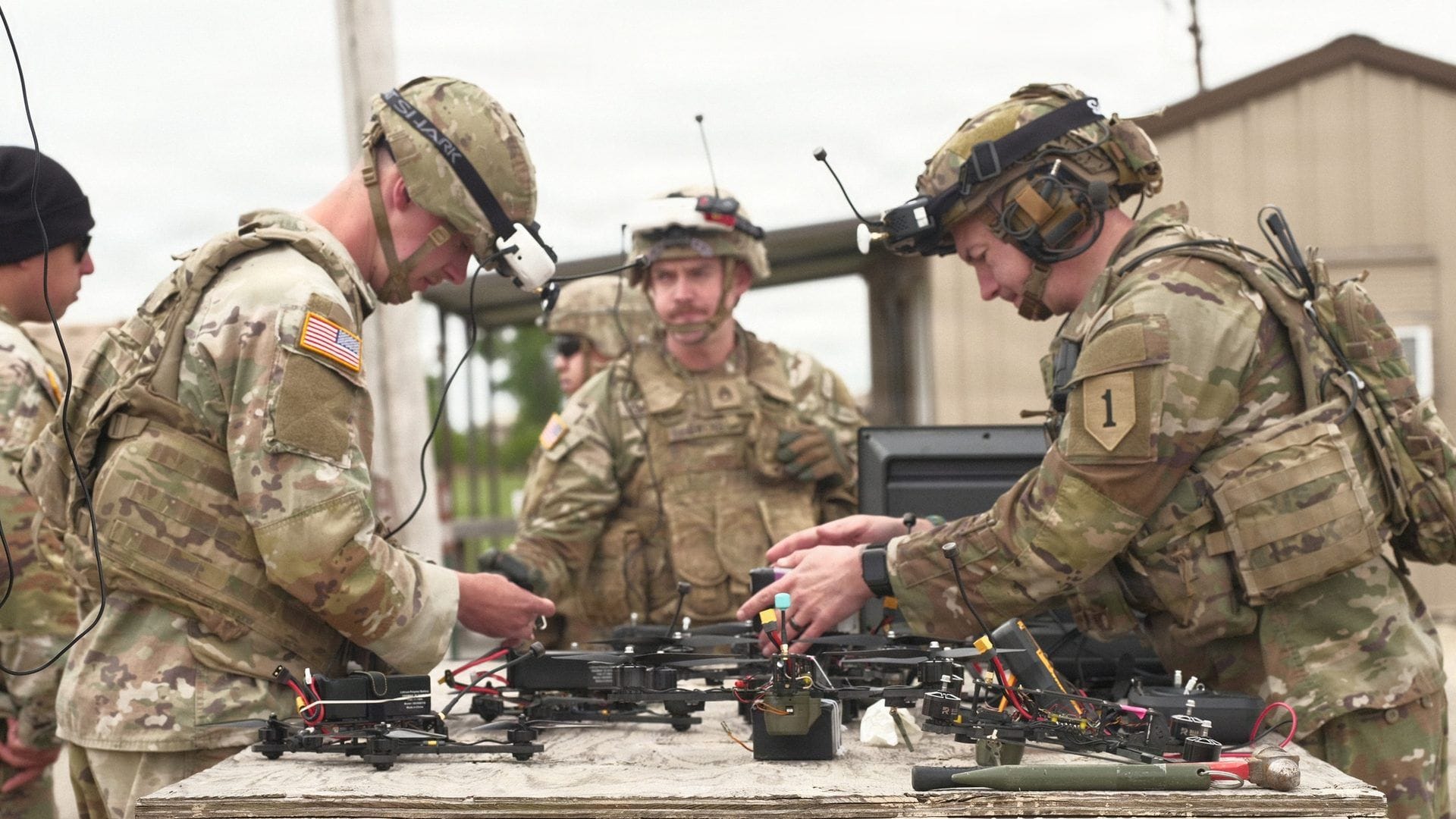
The memo ordered that every Army squad be equipped with small one-way attack drones by the end of fiscal 2026. Group 1 and Group 2 small drones weighing 55 pounds (about 25 kilograms) or less are to be classified as consumables rather than as equipment subject to turn-in and loss investigations, and authority to buy and operate them was delegated to frontline commanders. Experimental units testing the mass employment of small drones are to be stood up first in Indo-Pacific forces. "Small UAS resemble munitions more than high-end airplanes," Hegseth wrote in the memo. "They should be cheap, rapidly replaceable, and categorized as consumable."
The second step came last December. Using $1 billion from President Trump's "One Big Beautiful Bill," the Department of War presented industry with a plan to buy about 340,000 small one-way attack drones in four phases over two years. In phase one, 12 companies would build a total of 30,000 drones at an average of $5,000 each, worth $150 million; in later phases the number of vendors narrows to five, while order volume grows to 150,000 drones and the unit price falls to $2,300. "We will deliver tens of thousands of small drones to our force in 2026, and hundreds of thousands of them by 2027," Hegseth said in a video message. He noted that since the Cold War the number of defense contractors has shrunk from hundreds to dozens and that the Pentagon spent 30 years putting quality ahead of quantity, then said: "We cannot afford to shoot down cheap drones with $2 million missiles."
Phase one trials took place in February this year at Fort Benning, Georgia. Twenty-five invited companies brought prototypes and trained soldiers to operate them, and the soldiers themselves scored the drones by carrying out search, target-lock and strike missions. Weapons are selected on actual mission performance rather than paper requirements. In the results released in March, the top 11 companies received orders. Emil Michael, the Department of War's chief technology officer (CTO), said hundreds of companies had applied to take part. According to the program timeline, the next trial, Gauntlet 2.5, covering bomber-drone missions, will be held around November.
Thirty-nine days of war with Iran emptied the US arsenal of expensive missiles
The Iran war showed how urgent the shift to mass is. In a May 27 report, the Center for Strategic and International Studies (CSIS) concluded that 39 days of bombing and air-defense operations against Iran had sharply reduced key munitions stocks. The US Navy fired more than 1,000 Tomahawk cruise missiles in the war. Over the past 10 fiscal years (2015–2026), the United States procured an average of 86 Tomahawks a year. The Navy requested 785 missiles in its fiscal 2027 budget, but CSIS estimated that, after a 34-month production lead time, they will begin arriving only in March 2030.
Air-defense interceptors are even tighter. Since the start of the Iran war, the US military has reportedly used about four-fifths of its Terminal High Altitude Area Defense (THAAD) interceptor stockpile and about half of its Patriot interceptors. CSIS estimated prewar US inventories at about 2,200 interceptors of the two latest Patriot types and 452 THAAD rounds. In an October 5 paper, the Congressional Research Service (CRS) summarized that the military had expended about 1,700 Patriots, 200 THAADs and 150 SM-series ship-launched interceptors. In September, the Congressional Budget Office (CBO) estimated that the military "may have used between half and two-thirds" of some interceptor inventories.
Refilling them will take years. According to CSIS, THAAD is currently produced at a rate of 96 a year, and Lockheed Martin plans to raise that to 400 a year. About 650 of the latest Patriot (PAC-3 MSE) are built each year, but half go to allies and partners. Deliveries of the 3,203 Patriots the Army requested in fiscal 2027 will begin in May 2029. Hegseth himself said replenishing stocks will take "months to years, depending on the weapon system." The Trump administration included large munitions purchases in its $1.5 trillion fiscal 2027 defense budget and has signed a string of capacity-expansion agreements with defense contractors. "The problem now is not money but time," CSIS concluded. Under those agreements, Raytheon (RTX) aims to raise annual Tomahawk capacity to more than 1,000 missiles, and Lockheed Martin aims to lift Patriot output to 2,000 a year, the maximum its existing facilities can deliver.
The price of one Patriot buys more than 80 Shahed-type attack drones
The logic behind the turn to cheap drones is the cost-exchange ratio. In a February report last year, the CSIS Futures Lab put the price of one Iranian-designed Shahed-type one-way attack drone used by Russia at $35,000. The same report said a single Patriot PAC-3 interceptor costs more than $3 million. By that arithmetic, the price of one Patriot could build more than 80 Shahed-type drones.