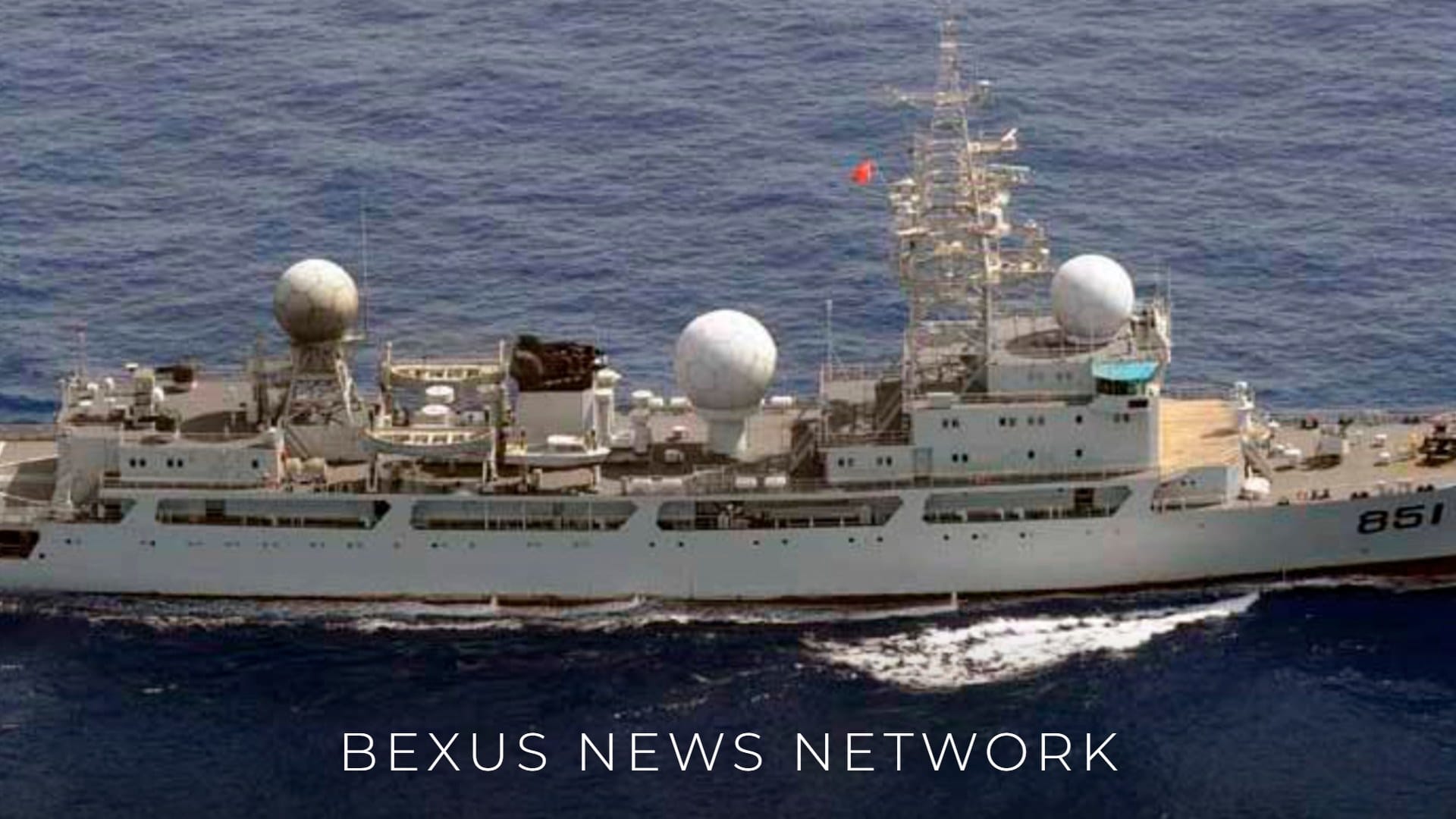
Two Chinese intelligence-gathering ships enter Pacific via Osumi Strait and Miyako waters just before U.S.-Japan Keen Sword 27
TOKYO
Two Chinese Navy Dongdiao-class intelligence-gathering ships passed through the Osumi Strait and the waters between Okinawa's main island and Miyako Island, respectively, into the Pacific on Oct. 17-18, ahead of the opening of the U.S.-Japan joint exercise Keen Sword 27. The Joint Staff of Japan's Ministry of Defense said in notices on Oct. 19 (local time) that the intelligence-gathering ship with hull number 796 passed between Okinawa's main island and Miyako Island and the ship with hull number 798 passed through the Osumi Strait. On Oct. 19, the day Keen Sword 27 began, two Chinese military drones and a Y-9 intelligence-gathering aircraft flew out over the Pacific, prompting Air Self-Defense Force fighters to scramble. The Joint Staff posted four notices on Chinese Navy vessels, one on Chinese military aircraft and two on Russian military aircraft on that day alone.
Dongdiao-class 796 heads south off Kume Island, passes between Okinawa and Miyako
According to the Joint Staff, the Maritime Self-Defense Force at around 11 a.m. on Oct. 17 (Saturday) spotted a Chinese Navy Dongdiao-class intelligence-gathering ship (hull number 796) sailing south about 80 km northwest of Kume Island, Okinawa Prefecture. The ship then passed south through the waters between Okinawa's main island and Miyako Island toward the Pacific. A P-1 patrol aircraft of the MSDF's Fleet Air Wing 5 (Naha Air Base) conducted surveillance and intelligence gathering.
Japan's Ministry of Defense classifies the Dongdiao class as "intelligence-gathering ships" (情報収集艦) in its announcements. The carrier Liaoning's group also passed through the same waters when it headed into the Pacific on Oct. 14. According to the Joint Staff's Oct. 14 notice, the Liaoning (hull number 16), two Renhai-class guided-missile destroyers and one Luyang III-class guided-missile destroyer were sailing south about 390 km southwest of the Danjo Islands, Nagasaki Prefecture, at around 11 a.m. on Oct. 13 (Tuesday) and passed southeast between Okinawa's main island and Miyako Island on Oct. 14. The MSDF deployed the destroyer Yugiri (Yokosuka) of Surface Division 1, a P-1 of Fleet Air Wing 4 (Atsugi) and a P-3C of Fleet Air Wing 5 (Naha), and the Air Self-Defense Force scrambled fighters in response to carrier-based aircraft takeoffs and landings.
The 796 also passed through the Osumi Strait in June this year. According to the Joint Staff's June 11 notice, the MSDF at around 6 a.m. on June 10 (Wednesday) spotted a Dongdiao-class intelligence-gathering ship (hull number 796) sailing northeast about 80 km west of Kuchinoerabu Island (Kagoshima Prefecture). The ship then passed east through the Osumi Strait toward the Pacific and was monitored by the Otaka (Sasebo) of Patrol Division 3. Four months later, the same ship entered the Pacific this time between Okinawa's main island and Miyako Island.
798 heads into Pacific from west of Kuchinoerabu Island via Osumi Strait
At around 3 p.m. the same day, the MSDF spotted a Dongdiao-class intelligence-gathering ship (hull number 798) sailing east about 100 km west of Kuchinoerabu Island. The Joint Staff said the ship passed east through the Osumi Strait toward the Pacific from Oct. 17 (Saturday) to Oct. 18 (Sunday). The Amakusa (Sasebo) of Surface Training Support Division 1 and a P-1 patrol aircraft of Fleet Air Wing 4 (Atsugi) were assigned to surveillance.
The two intelligence-gathering ships were first spotted four hours apart. They used different passages to exit into the Pacific on the same weekend. The Joint Staff did not disclose the ships' subsequent tracks or their areas of activity in the Pacific.
The Joint Staff did not link the Chinese ships' movements to Keen Sword 27. However, Oct. 17-18, when the Dongdiao-class ships headed into the Pacific, fell just before the start of the Keen Sword 27 exercise period (Oct. 19-29) announced by the Joint Staff on Sept. 29.
Five ships including two guided-missile destroyers and a supply ship move through the two passages the same weekend
Before the intelligence-gathering ships, five Chinese Navy surface ships also passed through the same passages. The MSDF at around 11 p.m. on Oct. 16 (Friday) spotted two ships, a Luyang III-class guided-missile destroyer (hull number 121) and a Fuyu-class fast combat support ship (hull number 901), sailing southeast about 140 km west of Kuchinoerabu Island. The two ships passed east through the Osumi Strait toward the Pacific on Oct. 17 (Saturday). The Mikuma (Sasebo) of Patrol Division 3 and a P-1 patrol aircraft of Fleet Air Wing 1 (Kanoya) monitored them.
Another group moved in the opposite direction. The MSDF at around 4 p.m. on Oct. 16 (Friday) spotted three ships, a Luyang III-class guided-missile destroyer (hull number 122), a Jiangkai II-class frigate (hull number 576) and a Fuchi-class supply ship (hull number 889), sailing northeast about 220 km south of Miyako Island (Okinawa Prefecture). The three passed northwest between Okinawa's main island and Miyako Island toward the East China Sea on Oct. 17 (Saturday). A P-1 of Fleet Air Wing 1 (Kanoya) and a P-1 of Fleet Air Wing 5 (Naha) conducted surveillance.
The Chinese Navy ships disclosed in the Joint Staff's Oct. 19 notices for Oct. 16-18 totaled seven. Of these, four headed into the Pacific and three moved from the Pacific side into the East China Sea. Of the four, three used the Osumi Strait and one used the waters between Okinawa's main island and Miyako Island. Earlier, the Liaoning (hull number 16), two Renhai-class guided-missile destroyers (hull numbers 103 and 104) and a Luyang III-class guided-missile destroyer (hull number 123) were spotted on Oct. 14 about 250 km south of Ishigaki Island. The Joint Staff said carrier-based fighters and helicopters of the group made about 10 takeoffs and landings, and the four ships headed for the South China Sea on Oct. 15.
On opening day Oct. 19, two drones and a Y-9 fly over inter-island waters into the Pacific
On Oct. 19 (Monday), the day Keen Sword 27 began, Chinese military aircraft were active. According to the Joint Staff, from the morning into the afternoon, one Chinese military BZK-005 reconnaissance drone and one Y-9 intelligence-gathering aircraft flew in from the East China Sea, passed between Okinawa's main island and Miyako Island and reached the Pacific. The two aircraft circled over the Pacific, then turned back and returned toward the mainland via the same route.
From the morning into the afternoon the same day, one TB-001 reconnaissance/attack drone took a different route. The TB-001 flew in from the East China Sea, passed between Yonaguni Island and Taiwan, reached the Pacific and flew as far as waters off Amami Oshima. The drone then turned back and headed toward the mainland via the passage between Okinawa's main island and Miyako Island. The ASDF's Southwestern Air Defense Force scrambled fighters in response.
Chinese drones also flew around Japan several times in October. The Joint Staff said that on the afternoon of Oct. 9 (Friday), one TB-001 flew in from the mainland side, changed course off Okinawa's main island, flew northeast, then turned again off the Danjo Islands, Nagasaki Prefecture, and returned. On the morning of Oct. 14 (Wednesday), one aircraft presumed to be a Chinese drone passed between Yonaguni Island and Taiwan and reached the Pacific, and that afternoon one Y-9 and one WZ-7 reconnaissance drone flew over the East China Sea. ASDF fighters scrambled on both days.
中国軍のTB-001偵察/攻撃型無人機が東シナ海上空を飛行することを確認・公表したのは今年度初めてです。
— 小泉進次郎 (@shinjirokoiz) June 13, 2026
この無人機は、長距離・長時間飛行能力を有し、対艦・対地ミサイルを搭載可能な機種と指摘されています。
引き続き警戒監視と対領空侵犯措置に万全を期してまいります。 https://t.co/GEwxwAMQmX
The TB-001 is a type the Joint Staff classifies in its notices as a "reconnaissance/attack drone." The Joint Staff's report on scrambles in the first half of fiscal 2026 listed TB-001 flights on two occasions, June 12 and Aug. 18, among the notable flight cases it published, and on both occasions it flew together with a Y-9. In October, in the second half of the fiscal year, TB-001 flights were also announced on Oct. 9 and Oct. 19.
令和8年8月18日(火)中国軍の情報収集機(Y-9)及び、偵察/攻撃型無人機(TB-001)が、長崎県男女群島沖から沖縄本島沖にかけて東シナ海上を飛行したことを確認し、これらに対して航空自衛隊 の西部航空方面隊等の戦闘機を緊急発進させ対応しました。 https://t.co/A6KtLEM6fj pic.twitter.com/8MlskzueNj
— 防衛省・自衛隊 (@ModJapan_jp) August 19, 2026
Osumi Strait is one of five "specified areas" where Japan limits its territorial sea to 3 nautical miles
The Osumi Strait, through which three Chinese ships passed, is a "specified area" under Japanese law. Article 1 of Japan's Act on the Territorial Sea and the Contiguous Zone (Act No. 30 of 1977) sets Japan's territorial sea as extending to "the line 12 nautical miles seaward from the baseline." Where this line goes beyond the median line measured from the baselines, the portion beyond it is limited to the median line. However, Paragraph 2 of the Supplementary Provisions of the same act provides that "for the time being" Article 1 does not apply to five "specified areas": the Soya Strait, the Tsugaru Strait, the eastern channel of the Tsushima Strait, the western channel of the Tsushima Strait and the Osumi Strait. The specified areas also include waters adjacent to them that are deemed to form a single unit with them in view of the routes ships normally navigate.
Under Paragraph 2 of the Supplementary Provisions, Japan's territorial sea in these five specified areas is limited to the waters up to the line 3 nautical miles seaward from the baseline and the lines drawn connecting to it. Paragraph 3 of the Supplementary Provisions states that "the extent of the specified areas and the lines provided for in the preceding paragraph shall be determined by Cabinet Order."
The ships that passed through the Osumi Strait this time were three: intelligence-gathering ship 798, guided-missile destroyer 121 and fast combat support ship 901. The MSDF assets monitoring them were the Amakusa and Mikuma from Sasebo and P-1 patrol aircraft from Kanoya and Atsugi. The Joint Staff's notices do not state that the Chinese ships entered Japan's territorial waters.
Dongdiao-class transits of Osumi Strait repeated this year with rotating hull numbers
Notices released by the Joint Staff this year show Dongdiao-class ships repeatedly passing through the Osumi Strait under different hull numbers. According to the April 13 notice, the MSDF at around 3 a.m. on April 11 (Saturday) spotted a Dongdiao-class intelligence-gathering ship (hull number 799) sailing southeast about 90 km west of the Kusagaki Islands (Kagoshima Prefecture). The ship passed east through the Osumi Strait toward the Pacific.
The Joint Staff said the 799 was the same ship that had passed northeast through the Tsushima Strait on March 29 (Sunday) and again passed southwest through the Tsushima Strait from April 9 (Thursday) to April 10 (Friday). It went northeast up the Tsushima Strait, came back down southwest, and the next day exited into the Pacific via the Osumi Strait. The Genkai (Kure) of Surface Training Support Division 1 and a P-1 of Fleet Air Wing 1 (Kanoya) were assigned to surveillance at the time.
令和8年4月11日、中国海軍ドンディアオ級情報収集艦が大隅海峡を東進し、太平洋へ向けて航行したことを確認しました。#防衛省・自衛隊 は、海上自衛隊の第1水上訓練支援隊所属「げんかい」(呉)及び第1航空群所属「P-1」(鹿屋)により、#警戒監視・情報収集 を行いました。… https://t.co/vrKpaBPUIm pic.twitter.com/dLZxODDpm8
— 防衛省・自衛隊 (@ModJapan_jp) April 13, 2026
In July there was also a transit in the opposite direction. According to the July 9 notice, the MSDF at around 9 a.m. on July 7 (Tuesday) spotted a Dongdiao-class intelligence-gathering ship (hull number 795) and a Haizhu 101-class rescue ship (hull number 861) sailing northwest about 80 km east of Tanegashima. The two ships passed west through the Osumi Strait toward the East China Sea and were monitored by the Harusame (Sasebo) of Surface Division 7. The Joint Staff said the 795 was the same ship that had passed northeast through the waters between Amami Oshima and Yokoate Island on June 29 (Monday). The Dongdiao-class hull numbers appearing as ships transiting the Osumi Strait in the April, June and July notices and the latest notices are four: 795, 796, 798 and 799.
Keen Sword 27 begins Oct. 19 with 45,000 SDF personnel and 40 ships
Keen Sword is a U.S.-Japan joint exercise that began in fiscal 1985 (Showa 60), and this year marks the 18th field training exercise. According to materials released by the Joint Staff on Sept. 29, Keen Sword 27 runs from Oct. 19 (Monday) to Oct. 29 (Thursday) in the sea and airspace around Japan, at SDF and U.S. Forces Japan facilities, at civilian airports and ports, and on public and private land in Japan. SDF participation totals about 45,000 personnel, about 6,100 vehicles, about 40 ships and about 260 aircraft. Besides U.S. and Australian forces, forces from Canada, France, Germany, the Netherlands, New Zealand and the Philippines are taking part. According to information provided by the North Kanto Defense Bureau to Saitama Prefecture, Iruma Air Base will be used as a takeoff and landing site for airborne training and other drills, and an outdoor temporary medical facility will be set up on the base for joint treatment training with U.S. forces and others. The materials list about 100 German Bundeswehr personnel with one A400M and one A321, about five personnel each from New Zealand and the Philippines, and about three from the Netherlands. The German A400M flew into Iruma Air Base on Oct. 16 and will stay until Oct. 29, and personnel arriving at Hyakuri Air Base on the A321 on Oct. 19 are scheduled to move to Iruma Air Base by Ground Self-Defense Force vehicles.
Chief of Staff of the Joint Staff Uchikura, asked about the scale of the exercise at a regular news conference on Oct. 9, said it was set to reflect both countries' training needs, adding: "Please consider the fact that it has become close to the largest scale as an expression of a sense of crisis and an expression of training needs (最大に近い規模となったことは、危機感の表れであり、訓練ニーズの表れだとお考えください)." He said SDF and U.S. forces would be deployed to island areas including the Sakishima Islands to practice a series of activities including command and control, unit transport, logistics and joint anti-surface warfare. In a separate answer on long-range missiles, Uchikura said the exercise "is not one with any specific country or region in mind (特定の国や地域を念頭に置いたものではなく)."
Defense Minister Koizumi said at a news conference after a Cabinet meeting on Oct. 16 that U.S. and Japanese Ospreys would use Miyako Airport and Ishigaki Airport to transport U.S. and Japanese equipment for training in the Sakishima area during Keen Sword 27. Koizumi said: "We intend to strive to keep the impact on local residents to a minimum (地域の皆様に対する影響、これを最小限にとどめるように努めていきたいと思います)."
Koizumi acknowledges limited intelligence and surveillance capability on Pacific side
Asked at the same news conference about the Liaoning group's advance into the Pacific, Koizumi said China's activities were increasing. "In recent years, China has been increasingly expanding and intensifying its military activities around our country (中国は近年、我が国周辺における軍事活動をますます拡大・活発化させており)," he said. He said China appeared to be seeking to improve its carrier operation capabilities and its ability to conduct operations in distant sea and airspace.
Koizumi also referred to gaps in Japan's surveillance. "As military activities by neighboring countries intensify in the Pacific, the Ministry of Defense and SDF's intelligence-gathering and warning and surveillance capabilities on the Pacific side are limited, and strengthening our defense posture is urgent (防衛省・自衛隊の太平洋側における情報収集・警戒監視能力は限定的であり、防衛体制の強化は急務です)," he said. On the revision of the three security documents within the year, he said: "I will refrain from discussing specific details, but we will deepen concrete and realistic consideration toward revision within the year."
Scramble figures also rose. According to the Joint Staff's Oct. 16 report, ASDF scrambles in the first half of fiscal 2026 (April 1-Sept. 30) totaled 442, up from 265 in the same period a year earlier. Of these, 285 were against Chinese aircraft (198 a year earlier) and 152 against Russian aircraft (59). Scrambles by the Southwestern Air Defense Force rose to 201 from 189 a year earlier.
A Russian military reconnaissance aircraft also flew toward Japan the same weekend. The Joint Staff said in a notice on Oct. 19 that from the morning into the afternoon of Oct. 17 (Saturday), one Russian IL-20 intelligence-gathering aircraft flew in from the mainland side, flew over the East Sea (Sea of Japan) as far as waters off Kyoto Prefecture, then changed course and returned. The ASDF scrambled fighters from the Northern Air Defense Force and other units.
Sources (KST)
- Joint Staff, Japan Ministry of Defense · 2026-10-19 · 中国海軍艦艇の動向について(ドンディアオ/沖縄本島ー宮古島間南進) · https://www.mod.go.jp/js/pdf/2026/p20261019_04.pdf
- Joint Staff, Japan Ministry of Defense · 2026-10-19 · 中国海軍艦艇の動向について(ドンディアオ/大隅海峡南東進) · https://www.mod.go.jp/js/pdf/2026/p20261019_05.pdf
- Joint Staff, Japan Ministry of Defense · 2026-10-19 · 中国海軍艦艇の動向について(ルーヤンⅢ/大隅海峡南東進) · https://www.mod.go.jp/js/pdf/2026/p20261019_03.pdf
- Joint Staff, Japan Ministry of Defense · 2026-10-19 · 中国海軍艦艇の動向について(ルーヤンⅢ、ジャンカイⅡ/沖縄本島ー宮古島間北西進) · https://www.mod.go.jp/js/pdf/2026/p20261019_02.pdf
- Joint Staff, Japan Ministry of Defense · 2026-10-19 · 中国軍機の動向について(BZK-005・Y-9・TB-001 与那台・沖宮) · https://www.mod.go.jp/js/pdf/2026/p20261019_06.pdf
- Joint Staff, Japan Ministry of Defense · 2026-10-19 · ロシア軍機の動向について(IL-20) · https://www.mod.go.jp/js/pdf/2026/p20261019_01.pdf
- Joint Staff, Japan Ministry of Defense · 2026-10-15 · 中国海軍艦艇の動向について(空母「遼寧」ほか3隻/発着艦実績/南シナ海へ) · https://www.mod.go.jp/js/pdf/2026/p20261015_02.pdf
- Joint Staff, Japan Ministry of Defense · 2026-10-14 · 中国海軍艦艇の動向について(空母「遼寧」ほか3隻) · https://www.mod.go.jp/js/pdf/2026/p20261014_01.pdf
- Joint Staff, Japan Ministry of Defense · press release list (7 items posted 2026-10-19) · https://www.mod.go.jp/js/press/index.html
- Joint Staff, Japan Ministry of Defense · 2026-10-14 · 中国軍機の動向について(UAV,Y-9,WZ-7) · https://www.mod.go.jp/js/pdf/2026/p20261014_02.pdf
- Joint Staff, Japan Ministry of Defense · 2026-10-09 · 中国軍機の動向について(TB-001) · https://www.mod.go.jp/js/pdf/2026/p20261009_02.pdf
- Joint Staff, Japan Ministry of Defense · 2026-07-09 · 中国海軍艦艇の動向について · https://www.mod.go.jp/js/pdf/2026/p20260709_01.pdf
- Joint Staff, Japan Ministry of Defense · 2026-06-11 · 中国海軍艦艇の動向について · https://www.mod.go.jp/js/pdf/2026/p20260611_01.pdf
- Joint Staff, Japan Ministry of Defense · 2026-04-13 · 中国海軍艦艇の動向について · https://www.mod.go.jp/js/pdf/2026/p20260413_01.pdf
- Joint Staff, Japan Ministry of Defense · 2026-10-16 · 2026年度上半期までの緊急発進実施状況について · https://www.mod.go.jp/js/pdf/2026/p20261016_07.pdf
- Joint Staff, Japan Ministry of Defense · 2026-09-29 · 令和8年度日米共同統合演習「Keen Sword27」(version posted by Saitama Prefecture) · https://www.pref.saitama.lg.jp/documents/287927/20260929tougoubakuryoukanbukouhyousiryou.pdf
- Saitama Prefecture · 2026-09-29 · 令和8年度日米共同統合演習(実動演習)(KS27)の実施について (information provided by the North Kanto Defense Bureau) · https://www.pref.saitama.lg.jp/a0101/kichitaisaku/jyouhouteikyou20260929.html
- Joint Staff, Japan Ministry of Defense · 2026-10-09 14:00 · 統合幕僚長記者会見 · https://www.mod.go.jp/js/about/message/2026/1009.html
- Japan Ministry of Defense · 2026-10-16 08:37 · 防衛大臣閣議後会見 · https://www.mod.go.jp/j/press/kisha/2026/1016a.html
- e-Gov Laws and Regulations Search · 領海及び接続水域に関する法律(昭和52年法律第30号) Article 1, Supplementary Provisions Paragraphs 2 and 3 · https://laws.e-gov.go.jp/law/352AC0000000030 (text: https://laws.e-gov.go.jp/api/1/lawdata/352AC0000000030)