Rubio joins five Central Asian nations on mineral supply chains; U.S.-Uzbekistan business council produces 54 agreements and initiatives worth about $12 billion
WASHINGTON · SAMARKAND
U.S. Secretary of State Marco Rubio held a C5+1 foreign ministers' meeting on the 19th (local time) at the Congress Center in Samarkand, Uzbekistan, with the foreign ministers of the five Central Asian nations: Kazakhstan, Kyrgyzstan, Tajikistan, Turkmenistan and Uzbekistan. The six governments issued a joint statement that day titled "C5+1: Historic Partnership, Prosperous Future," agreeing on sharing geological data and expanding mineral mining and processing. At the U.S.-Uzbekistan Business and Investment Council held that evening, Uzbek President Shavkat Mirziyoyev said a package of 54 "agreements and promising initiatives" worth about $12 billion had been put together, citing industry, energy, transportation, agriculture, education and new technologies as areas of cooperation. The next day in Mumbai, India, Rubio, addressing claims that intelligence sharing with Ukraine had been cut off, said the president had ordered no such changes and that nothing had changed.
Rubio packs foreign minister talks, C5+1 meeting and presidential meeting into one day
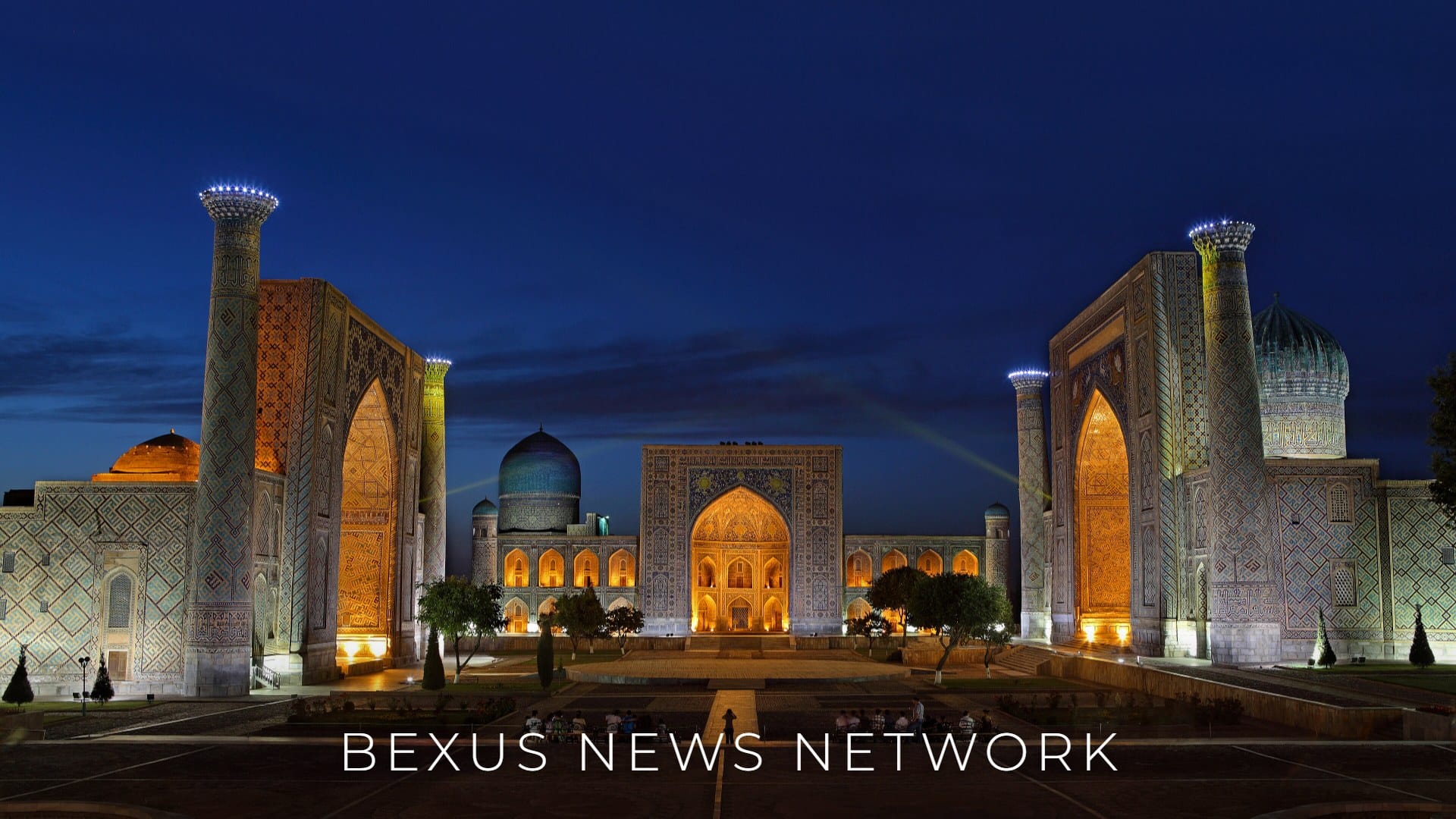
According to the State Department's public schedule for the 19th, Rubio toured Registan Square at 8:45 a.m. and then met Uzbek Foreign Minister Bakhtiyor Saidov at 9:45. At 10:10 he attended a signing ceremony with Saidov, and at 10:20 he met Kazakh Foreign Minister Mukhtar Tileuberdi. The C5+1 foreign ministers' meeting began at 11:40 a.m. In the afternoon Rubio had lunch with the Central Asian foreign ministers, met Mirziyoyev at 6:30 p.m. and then attended the Business and Investment Council dinner at 7:30.
Before departing, Rubio was asked at Joint Base Andrews on the 17th why he was going to Uzbekistan at a time of overlapping crises. Rubio replied that it was the right time for those leaders, and that it was not just Uzbekistan but also the other four Central Asian countries. Rubio said that if one only goes to places because of crises or meetings, strategic work gets pushed aside. Rubio explained that his visits to Greece a few weeks earlier, and to Latin America before that, were also aimed at building relationships.
In opening remarks at the meeting with Mirziyoyev, Rubio said preparations for this C5+1 meeting began three months earlier. Rubio named energy, critical minerals, agriculture, transportation and technology as areas of cooperation. Mirziyoyev responded that thanks to Trump's efforts, Central Asia is receiving U.S. strategic attention for the first time. Mirziyoyev also said a dialogue for an enhanced strategic partnership had begun that day.
Joint statement says "Data is gold," covers geological data sharing and mineral processing
The joint statement, released by the State Department as a media note, is organized into seven sections. The first section describes the United States and Central Asia as "enduring partners of choice." The statement also notes that the five Central Asian nations mark the 35th anniversary of their independence this year and the United States the 250th anniversary of its independence.
Mineral cooperation was included in the energy section. The statement said each country has unique natural resources that have yet to be developed, and that they would jointly lead development of the region's energy sector. Declaring "Data is gold," the statement said they would exchange expertise and best practices on managing geological data. The six countries said they would expand opportunities for mineral mining and processing and create pathways to increase value-added products within Central Asia and bring them to international markets. The body of the statement referred to mineral mining and processing rather than using the term "critical minerals."
In the connectivity section, the statement said they are strengthening mutually beneficial partnerships along the Trans-Caspian Trade Route. The economic section included harmonization of customs procedures. The statement said they would create new, mutually beneficial business opportunities for U.S. companies operating in Central Asia and expand opportunities for Central Asian companies to invest in and enter the U.S. market. The security section included countering terrorism and transnational organized crime, border security, and nuclear security cooperation based on the Central Asian Nuclear-Weapon-Free Zone. China and Russia were not named in the body of the statement.
Rubio says U.S. will not rely on "risky foreign partners or even adversaries"
At the foreign ministers' meeting, Rubio said Central Asia had historically been a crossroads of trade between West and East. Rubio said last year's C5+1 summit at the White House produced $25 billion in new deals, strengthening the transportation, energy and finance sectors. He said the United States would bolster Trans-Caspian Trade Route infrastructure and secure an energy future by building integrated, high-value supply chains through a critical minerals dialogue.
The supply chain issue was framed in the language of security. Rubio said the United States seeks to secure its critical industries and the supply chains that support them, so that, as a sovereign, independent nation and economy, it does "not ever have to rely on risky foreign partners or even adversaries." No specific country was named. Rubio also said the United States would prepare thousands of young professionals to use and support advanced American technologies.
Saidov presented strengthening economic connectivity, attracting technology and investment, and access to global markets as the agenda for the meeting. Saidov proposed a strategic partnership in the critical minerals sector spanning geological exploration and mineral processing. Saidov noted that the first C5+1 foreign ministers' meeting was held in 2015, and praised the work of Turkmenistan, which served as co-chair of the C5+1 secretariat in 2025-2026. Uzbekistan took over the co-chairmanship this time. Saidov said Central Asia has become stronger and more united and has built up the capacity to shape its own future. Saidov said he was grateful that the United States has consistently supported the sovereignty, independence and territorial integrity of the Central Asian countries.
Mirziyoyev touts package of 54 items worth about $12 billion
The U.S.-Uzbekistan Business and Investment Council was held at the Congress Center. Mirziyoyev said "a package of 54 agreements and promising initiatives worth approximately 12 billion U.S. dollars" had been put together. The figure includes not only agreements but also "promising initiatives." Earlier, in opening remarks at the meeting with Rubio, Mirziyoyev said agreements worth $12 billion had been reached. The State Department transcript does not give an itemized list of the 54 items or amounts by sector.
Mirziyoyev named industry, energy, transportation, agriculture, education and new technologies as areas of cooperation. Mirziyoyev said Uzbekistan is changing the way it works with investors to a new model based on a "plug and play" principle. He also said Uzbekistan is ready to set up a direct investment fund to take part in such projects. Mirziyoyev said Uzbekistan has substantial natural resources and is ready to be a reliable partner of the United States in this area, and that Uzbek companies have also begun investing in the U.S. economy.
Saida Mirziyoyeva, head of the Presidential Administration and co-chair of the Business and Investment Council, told the participating companies that every company present would have a name to contact and that issues they raise would be passed directly to the co-chairs. Addressing Rubio, Mirziyoyeva said the secretary had called the Jackson-Vanik Amendment a relic of the Cold War, and that Uzbekistan agrees and would like to see it repealed. The transcript does not say when Rubio said this, and Rubio's speech that day also made no mention of Jackson-Vanik.
Rubio says U.S. is helping modernize Uzbekistan's critical mineral mining and processing capacity
In his speech at the Business and Investment Council, Rubio said the United States is strengthening the security of its critical mineral supply chains. Rubio explained that, together with partners such as the Colorado School of Mines, the United States is modernizing or helping to modernize Uzbekistan's critical mineral mining and processing capacity. In energy, he cited projects to introduce U.S.-made small modular reactors (SMRs) and to modernize Uzbekistan's power grid and gas pipeline network. He also highlighted cooperation between the University of Texas at Dallas and the Samarkand quantum center.
Specific figures were given for aviation. Rubio said Boeing and GE Aerospace are providing engines, parts and training for Uzbek passenger aircraft. Rubio said Boeing sold 22 787 Dreamliner wide-body aircraft to Uzbekistan Airways last year. He said Uzbekistan's airports handled 15.5 million passengers last year, up 15% from the previous year, with Tashkent International Airport alone handling nearly 10 million. He said cargo rose 12% to 98,200 tons. As an example of Uzbek investment in the United States, he cited AKFA Group's $80 million investment in Bowling Green, Kentucky.
Sergio Gor, special envoy for South and Central Asia and co-chair of the business council, set out three priorities for the council: first, infrastructure; second, critical minerals; and third, new industries including aerospace and superintelligence. On critical minerals, Gor said the countries would jointly develop mineral resources for the benefit of all. Gor said the United States had for too long paid no attention to the region and focused on the East and the Middle East, and that the opportunity came when Trump returned to the White House. Gor said this changed when Trump held the first C5+1 summit at the White House. Gor also said he looks forward to welcoming the president at the G20 this December, for the first time ever. Gor said some partners come with loans on opaque terms and projects that put their own interests first, but did not name any specific country.
Uzbekistan signs Artemis Accords as 77th nation
According to the State Department's readout of the meeting, Saidov signed the Artemis Accords as Rubio looked on. The State Department said Uzbekistan became the 77th nation to join this commitment to peaceful and transparent space exploration. Rubio welcomed Uzbekistan's interest in U.S. civil nuclear technology. The two ministers discussed space cooperation, opportunities for U.S. companies in Uzbekistan's space sector and deepening critical minerals cooperation. The two ministers also discussed ways to further deepen the enhanced strategic partnership ahead of the upcoming G20 summit.
At the meeting with Rubio, Mirziyoyev expressed thanks for a document related to nuclear energy cooperation, calling it a very important cooperation document. Mirziyoyev asked Rubio to convey his regards to Trump, and Rubio replied that Trump had asked him to convey thanks for Mirziyoyev's leadership and openness.
Rubio reiterates "nothing has changed" on intelligence sharing with Ukraine
Having finished his Central Asia schedule, Rubio met reporters on the 20th at the Taj Mahal Palace Hotel in Mumbai, India. Rubio said he had spoken with Zelensky by phone for 45 minutes that day and that he was seeing a lot of inaccurate reporting in the media. On intelligence sharing, Rubio said, "The President made it very clear he's ordered no such changes." He went on to say he had seen reports that it had changed, but they were inaccurate and not true.
On undetected air strikes in Ukraine, Rubio said they were not because the United States had withheld information. Rubio said that if such incidents happened on the 13th and 18th, they were technical problems and not due to any U.S. instruction not to give early warning. Rubio said the United States is looking into the possibility of internal problems on the Ukrainian side in receiving the information provided, and that it is still providing the same warnings.
On interceptor missiles, Rubio explained that the United States also has its own needs. Rubio said interceptors are probably the most in-demand product in the defense sector right now, and that nothing is being deliberately denied to Ukraine. Rubio said there are minimum levels that must be met for U.S. military bases overseas, including bases in Europe, and added that the pace of U.S. interceptor production is rising quickly. On Trump's frustration, Rubio explained that the president does not like being blamed for things that are not true. Rubio said the war must end through a negotiated settlement.
The Ukrainian Presidential Office released the results of the call on the 20th. According to the office, Zelensky thanked Rubio for his position and readiness to help on the issue of ballistic missile interceptors, early warning of Russian ballistic missile attacks and the need to restore Starlink and Starshield. Zelensky also expressed thanks for Rubio's constructive position, and the two agreed to speak again soon. On Starshield, a military product, Rubio had said at Andrews on the 17th that it is currently not available to Ukraine and is under discussion.
China asserts rare earth export controls on Japan are in accordance with the law
At the Chinese foreign ministry's regular briefing on the 21st, two days after the Central Asia meeting, the issue of rare earth export controls came up. The question concerned Japan asking the United States to seek an easing of Chinese export controls because its stocks of the rare earth yttrium could run out within months. Spokesperson Mao Ning replied, "China implements export controls on Japan in accordance with the laws and regulations." Mao asserted that the measures are intended to thwart Japan's remilitarization and attempt to possess nuclear weapons, and said "All parties have the responsibility to play a constructive role to this end."
Sources (KST)
- U.S. State Department media note · 2026-10-19 · C5+1: Historic Partnership, Prosperous Future · https://www.state.gov/releases/office-of-the-spokesman/2026/10/c51-historic-partnership-prosperous-future/
- U.S. State Department transcript · 2026-10-19 · Secretary of State Marco Rubio and Uzbekistan Foreign Minister Bakhtiyor Saidov at the C5+1 Ministerial · https://www.state.gov/releases/office-of-the-spokesman/2026/10/secretary-of-state-marco-rubio-and-uzbekistan-foreign-minister-bakhtiyor-saidov-at-the-c51-ministerial
- U.S. State Department transcript · 2026-10-19 · Secretary of State Marco Rubio at the U.S.-Uzbekistan Business and Investment Council · https://www.state.gov/releases/office-of-the-spokesman/2026/10/secretary-of-state-marco-rubio-at-the-u-s-uzbekistan-business-and-investment-council/
- U.S. State Department transcript · 2026-10-19 · Secretary of State Marco Rubio and Uzbekistan President Shavkat Mirziyoyev Before Their Meeting · https://www.state.gov/releases/office-of-the-spokesman/2026/10/secretary-of-state-marco-rubio-and-uzbekistan-president-shavkat-mirziyoyev-before-their-meeting/
- U.S. State Department meeting readout · 2026-10-19 · Secretary Rubio's Meeting with Uzbekistan Foreign Minister Saidov · https://www.state.gov/releases/office-of-the-spokesman/2026/10/secretary-rubios-meeting-with-uzbekistan-foreign-minister-saidov/
- U.S. State Department · 2026-10-19 · Public Schedule October 19, 2026 · https://www.state.gov/releases/office-of-the-spokesman/2026/10/public-schedule-october-19-2026
- U.S. State Department transcript · 2026-10-17 (local, Joint Base Andrews) · Secretary of State Marco Rubio Remarks to the Press · https://www.state.gov/releases/office-of-the-spokesman/2026/10/secretary-of-state-marco-rubio-remarks-to-the-press-18/
- U.S. State Department transcript · 2026-10-20 (local, Mumbai) · Secretary of State Marco Rubio Remarks to the Press · https://www.state.gov/releases/office-of-the-spokesman/2026/10/secretary-of-state-marco-rubio-remarks-to-the-press-19/
- Office of the President of Ukraine · 2026-10-20 16:06 KST (Kyiv 10:06) · Early Warning of Russian Ballistic Missile Attacks and the Situation with Starlink/Starshield: Volodymyr Zelenskyy Had a Conversation with Marco Rubio · https://www.president.gov.ua/en/news/rannye-poperedzhennya-pro-rosijski-ataki-balistikoyu-ta-situ-106965
- Chinese Ministry of Foreign Affairs · 2026-10-21 · Foreign Ministry Spokesperson Mao Ning's Regular Press Conference on October 21, 2026 · https://www.mfa.gov.cn/eng/xw/fyrbt/lxjzh/202610/t20261021_12044543.html