U.S. rule to block Chinese ESS from power grid due in December; China's battery export control suspension set to expire November 10
WASHINGTON · SEOUL
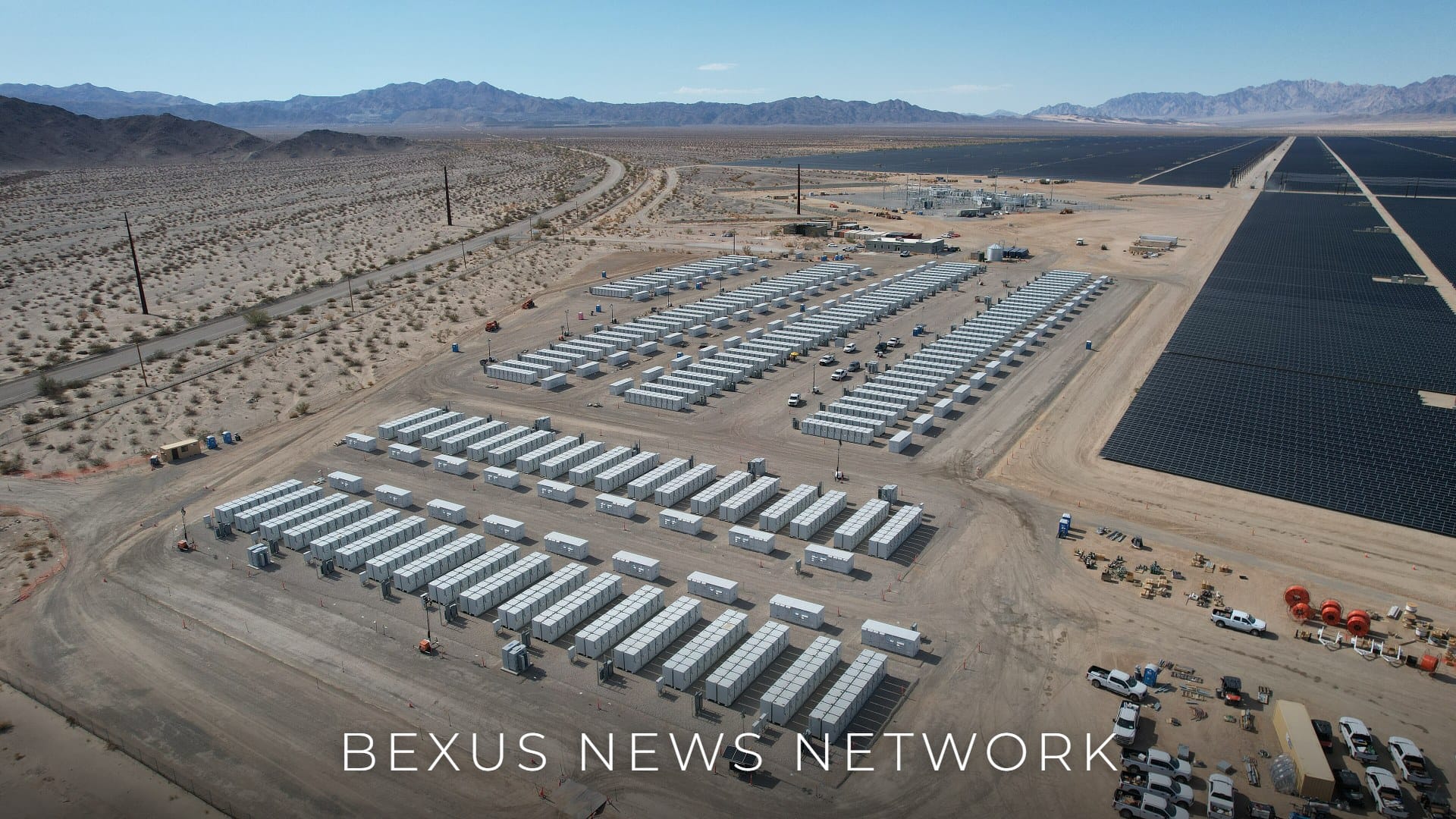
The U.S. Department of Energy must issue implementing rules by December 24 to block the purchase and installation of foreign battery energy storage systems (ESS), inverters and transformers used in the bulk-power grid. This is because Executive Order 14421, signed by President Donald Trump on August 26 (U.S. Eastern Time), requires the rules to be released within 120 days of signing. China's Ministry of Commerce has suspended export controls on lithium batteries and artificial graphite anode materials since November 2025; the suspension deadline stated in the announcement is November 10, 2026, and as of October 22 no ministry announcement of an extension or lifting has been confirmed. South Korean battery makers' earnings are already tied to U.S. policy. Of LG Energy Solution's preliminary third-quarter operating profit of 756 billion won, announced on October 8, 416.9 billion won came from the U.S. Advanced Manufacturing Production Credit (45X).
Trump places bulk-power grid equipment under a national emergency
The executive order's original title is "Declaring a National Emergency to Secure the United States Bulk-Power System." Its legal bases are the International Emergency Economic Powers Act (IEEPA) and the National Emergencies Act. It was received by the Federal Register at 11:15 a.m. (U.S. Eastern Time) on August 28 and published on August 31.
Section 1 of the order defines the threat as follows: "Certain foreign actors are increasingly creating and exploiting vulnerabilities." The target is the U.S. bulk-power system. The order determined the situation to be an "unusual and extraordinary threat." It also stated that foreign-made equipment may contain "digital backdoors" allowing foreign remote access. Reliance on foreign suppliers "creates a supply chain vulnerability," the order said.
The definitions in Section 5 set the regulated equipment as items used in substations, control rooms and power plants. The list explicitly includes battery ESS along with inverters, transformers, circuit breakers, protective relays and industrial control systems. Software, firmware and remote access functions accompanying the equipment may also be included. The bulk-power system refers to transmission lines of 69 kilovolts (kV) or higher and related facilities, as well as generation facilities needed for system reliability. Local distribution networks are excluded. The White House fact sheet also stated, "The Order does not apply to facilities used for local distribution of electric energy."
Ban applies to transactions in foreign equipment tied to "Covered Foreign Entities"
The order defines foreign as not manufactured, produced or assembled in the United States. Not all foreign-made equipment is blocked, however. Section 2(a) prohibits the acquisition, importation, transfer and installation of foreign bulk-power system equipment. The ban applies when the secretary of energy determines that the equipment is associated with a "Covered Foreign Entity" and poses an undue risk. It covers transactions initiated after the order was signed.
Covered foreign entities are countries subject to U.S. arms embargoes or sanctions, and persons tied to their governments. Countries or persons the secretary of energy determines to be engaged in harmful conduct are also included. This designation involves consultation with the national security adviser. Prohibition determinations under Section 2(a) are made by the secretary of energy in coordination with the director of the Office of Management and Budget and in consultation with the secretaries of war, commerce and homeland security and the Director of National Intelligence (DNI). Neither the text of the executive order nor the Energy Department's request for information names any specific country, including China.
Equipment already installed can also be addressed. Under Section 2(b), the secretary of energy may attach conditions to existing equipment, including "requirements to identify, isolate, monitor, secure, disconnect, replace, or remove such equipment." Before ordering removal, the secretary considers system reliability and safety and "the availability of secure replacements, and continuity of essential service." Phased implementation schedules may also be set. Evasive transactions intended to avoid violations, attempts at them and conspiracies are also prohibited.
A path was also left open. The secretary may make risk mitigation measures a precondition for approving transactions and may create a licensing process for prohibited transactions. The secretary may also set "prequalification" criteria that pre-screen equipment and suppliers to exempt them from the ban, and publish a list of them.
Energy Department must issue implementing rules by December 24
Section 3(b) of the executive order requires the secretary of energy to publish implementing rules within 120 days. The rules may include designation of covered foreign entities and licensing procedures for prohibited transactions. The 120th day from the signing date of August 26 is December 24. Section 4 requires recommended amendments to the Federal Acquisition Regulation (FAR) within 180 days, and requires the FAR Council to consider whether to publish proposed amendments within 90 days of receiving the recommendations. Section 6 requires periodic and final reports on the emergency to be submitted to Congress.
The Energy Department's Office of Cybersecurity, Energy Security, and Emergency Response (CESER) said in a notice posted on September 14, "DOE will move quickly to execute the executive order and issue implementing rules within 120 days." The department said it would gather input from utilities, state governments and manufacturers to create a predictable path for existing equipment and future transactions. The notice was revised on October 7.
Energy Department asks industry about the scope of battery ESS and inverters
On September 9, the Energy Department published a request for information (RFI) titled "Securing the United States Bulk-Power System" in the Federal Register (document number 2026-18370, Regulation Identifier Number 1901-AB79). Comments were accepted for 30 days from the date of publication. An online briefing (webinar) was held from 3 p.m. to 4 p.m. (U.S. Eastern Time) on September 16.
The first group of questions in the RFI (A-2) concerns scope. The department asked which equipment, such as grid-connected large inverters and battery ESS, needs a clearer definition. It also sought comment on which objective criteria among voltage, capacity, connection method, function, location and criticality should be used to set the scope without security gaps. A-5 asks whether "foreign-made" should be determined by final assembly, substantial transformation, contract manufacturing or foreign-made key components. A-6 asked about mechanisms to prevent circumvention such as splitting transactions or relabeling.
B-1 through B-7 concern supply chains. The department asked how to identify foreign ownership and control, how many tiers of subcontractors should be traced, and how to manage suppliers and remote access. D-1 through D-4 concern equipment already installed. Questions included what equipment information owners currently manage, what means exist to isolate or replace risky equipment, and what reliability factors should be weighed before a removal order. Domestic manufacturing (F), federal procurement (F-4), economic effects including the impact on small businesses (G), and standards and third-party certification (H-3) were also on the list of questions.
Tax credit threshold already applies to ESS beginning construction this year
Separately from grid regulation, a barrier on the tax side went up first. The U.S. Treasury Department and the Internal Revenue Service (IRS) issued press release IR-2026-23 and guidance Notice 2026-15 on February 12 (U.S. Eastern Time). The guidance follows the One, Big, Beautiful Bill, enacted on July 4, 2025, which added "material assistance" restrictions from "prohibited foreign entities" to the clean electricity tax credits (Sections 45Y and 48E) and the Advanced Manufacturing Production Credit (Section 45X). Prohibited foreign entities are divided into specified foreign entities and foreign-influenced entities.
According to the guidance, the Section 45Y and 48E restrictions apply to facilities beginning construction after December 31, 2025. For ESS beginning construction in 2026, the ratio of total direct costs minus direct costs attributable to prohibited foreign entities, the material assistance cost ratio (MACR), must not fall below 55%. The prohibited foreign entity restrictions under Section 45X apply to taxable years beginning after July 4, 2025. The Treasury and IRS said they plan to issue proposed regulations defining prohibited foreign entities. The law requires the Treasury to issue new safe harbor tables no later than December 31, 2026.
A structure in which U.S. power producers can lose tax credits if they use large amounts of batteries from prohibited foreign entities is already in operation for projects beginning construction this year. If the grid executive order is fleshed out through implementing rules, ESS connected to transmission networks of 69 kV or higher will have to clear two gates together: taxes and purchase and installation approval.
China holds battery export control suspension deadline at November 10
The Chinese government holds the battery supply chain as a means of retaliation. On October 9, 2025, China's Ministry of Commerce and the General Administration of Customs issued Announcement No. 58, the "Decision to Implement Export Controls on Items Related to Lithium Batteries and Artificial Graphite Anode Materials (公布对锂电池和人造石墨负极材料相关物项实施出口管制的决定)." According to the original text published in a circular by the Trade and Industry Department of the Hong Kong Special Administrative Region Government, the controls cover rechargeable lithium-ion batteries with a gravimetric energy density of 300 watt-hours (Wh) per kg or more, and manufacturing equipment such as winding and stacking machines. Lithium iron phosphate (LFP) cathode materials with a compaction density of 2.5 g per cubic centimeter or more and a specific capacity of 156 milliampere-hours (mAh) per gram or more, ternary cathode material precursors such as nickel-cobalt-manganese, and artificial graphite anode materials and their manufacturing equipment, processes and technologies were also covered. The equipment list included graphitization furnaces and continuous graphitization furnaces, roller kilns and high-speed mixers. "Continuous graphitization technology (连续石墨化技术)" was included among the technology control items. The announcement was set to take effect on November 8, 2025.
Just before implementation, China halted the measure. On November 7, 2025, the Ministry of Commerce and the General Administration of Customs suspended the implementation of Nos. 55, 56, 57 and 58 and Ministry of Commerce Announcements Nos. 61 and 62 through Announcement No. 70. The text of the announcement stated the suspension runs "自即日起至2026年11月10日" (from today until November 10, 2026). Two days later, on November 9, the Ministry of Commerce, through Announcement No. 72, also suspended until November 27, 2026, the implementation of Paragraph 2 of its announcement strengthening export controls on dual-use items targeting the United States (No. 46 of 2024).
November 10, when the suspension ends, is 44 days before the U.S. Energy Department's rule deadline. If the controls take effect, exporters will have to apply for a license from the commerce authority under the State Council each time they ship these items, and enter dual-use item information in the remarks column of the customs declaration.
LG Energy Solution fills 416.9 billion won of its 756 billion won Q3 operating profit with U.S. tax credits
South Korean companies' earnings are intertwined with U.S. policy. On October 8, LG Energy Solution announced preliminary third-quarter results of 9.6434 trillion won in revenue and 756 billion won in operating profit. Revenue rose 59.0% and operating profit 25.7% from the same period a year earlier. Compared with the previous quarter, revenue rose 27.6% and operating profit 567.3%.
These results include 416.9 billion won in North American production subsidies under the U.S. Advanced Manufacturing Production Credit (45X). According to figures disclosed by the company alongside the results, excluding this amount, revenue would be 9.2265 trillion won and operating profit 339.1 billion won, for an operating margin of 3.7%. The tax credit amount was 77.8 billion won more than operating profit excluding the tax credits. Starting in the first quarter of 2026, the company changed the way it presents North American production subsidies in its financial statements to "revenue and other income." Cumulative revenue for the first three quarters was 23.7586 trillion won and operating profit 661.6 billion won. These figures are preliminary results estimated under Korean International Financial Reporting Standards (K-IFRS).
Section 45X also carries prohibited foreign entity restrictions for taxable years beginning after July 4, 2025. For battery cells and modules made at U.S. plants to continue receiving the tax credit, the share of prohibited foreign entities must also be managed in the procurement of materials and components. The preliminary earnings press release did not separately disclose ESS segment revenue or orders.
U.S. and Chinese deadlines cluster in November and December
Most of the remaining schedule is concentrated before the end of the year. China's suspension of lithium battery and graphite anode export controls ends on November 10, and its suspension of dual-use controls targeting the United States ends on November 27. The U.S. Energy Department's implementing rules on grid equipment must be issued by December 24, and the Treasury's new tax credit safe harbor tables have a statutory deadline of December 31. Recommendations for amending the Federal Acquisition Regulation are due by February 2027, 180 days after signing.
Depending on which countries the Energy Department's rules place on the list of covered foreign entities, and how they draw ESS capacity and voltage criteria, it will be determined how far the door to the U.S. ESS market for transmission grids actually closes. Which suppliers make the prequalification list is also a variable directly tied to South Korean battery makers' U.S. orders.
Sources (KST)
- White House · 2026-08-27 (U.S. Eastern 2026-08-26) · Declaring a National Emergency to Secure the United States Bulk-Power System · https://www.whitehouse.gov/presidential-actions/2026/08/declaring-a-national-emergency-to-secure-the-united-states-bulk-power-system/
- White House · 2026-08-27 (U.S. Eastern 2026-08-26) · Fact Sheet: President Donald J. Trump Declares a National Emergency to Secure America's Bulk-Power System · https://www.whitehouse.gov/fact-sheets/2026/08/fact-sheet-president-donald-j-trump-declares-a-national-emergency-to-secure-americas-bulk-power-system/
- U.S. Federal Register · published 2026-08-31 · Executive Order 14421, FR Doc. 2026-17843 · https://public-inspection.federalregister.gov/2026-17843.pdf
- U.S. Department of Energy CESER · 2026-09-15 (U.S. Eastern 09-14), revised 10-07 · Declaring a National Emergency to Secure the United States Bulk-Power System Executive Order · https://www.energy.gov/node/4860229
- U.S. Federal Register · published 2026-09-09 · DOE Request for Information: Securing the United States Bulk-Power System, FR Doc. 2026-18370 · https://public-inspection.federalregister.gov/2026-18370.pdf
- U.S. Internal Revenue Service · 2026-02-13 (U.S. Eastern 02-12) · IR-2026-23 · https://www.irs.gov/newsroom/treasury-irs-provide-guidance-for-certain-energy-tax-credits-regarding-material-assistance-provided-by-prohibited-foreign-entities-under-the-one-big-beautiful-bill
- U.S. Internal Revenue Service · 2026-02-13 · Notice 2026-15 · https://www.irs.gov/pub/irs-drop/n-26-15.pdf
- Hong Kong SAR Government Trade and Industry Department · 2025-10 · Chinese Ministry of Commerce and General Administration of Customs Announcement No. 58 of 2025 · https://www.tid.gov.hk/en/tradecircular/files/2025/ci9022025a.pdf
- Hong Kong SAR Government Trade and Industry Department · 2025-11 · Chinese Ministry of Commerce and General Administration of Customs Announcement No. 70 of 2025 · https://www.tid.gov.hk/en/tradecircular/files/2025/ci9772025a.pdf
- Hong Kong SAR Government Trade and Industry Department · 2025-11 · Chinese Ministry of Commerce Announcement No. 72 of 2025 · https://www.tid.gov.hk/en/tradecircular/files/2025/ci9782025a.pdf
- LG Energy Solution · 2026-10-08 · 2026년 3분기 잠정실적 발표 · https://www.lg.co.kr/media/release/30650