Amid 11 Months of Silence, Soldiers Injured by North Korean Mine; Defense Ministry Proposes Military Talks Again
SEOUL
While North Korea has failed to respond to a proposal for inter-Korean military talks for nearly 11 months, South Korean service members were injured in an explosion involving a landmine planted by the North in the Demilitarized Zone (DMZ). On the 23rd, the Ministry of National Defense released an official statement in the name of Kim Hong-cheol, Deputy Minister for National Defense Policy, renewing its proposal to North Korea to hold inter-Korean military talks to verify the location of the ground Military Demarcation Line (MDL), restore military communication lines, and prevent accidental clashes in the border area. The ministry stated that the North has "failed to respond" to a previous proposal made under the same deputy minister's name on November 17, 2025. Exactly 340 days have passed between the two proposals.
Defense Ministry Puts Inter-Korean Military Talks Back on the Table After 11 Months
The core of the proposal statement issued by Deputy Minister Kim on the 23rd is: "We officially propose to North Korean authorities to hold inter-Korean military talks to mutually verify the clear location of the ground Military Demarcation Line between the South and the North, and discuss measures to restore military communication lines and prevent accidental clashes in the border area."
Kim also broadened the format. "If necessary, three-way talks including the United Nations Command are also possible," he said. He stated that the schedule and venue for the talks "could be discussed through Panmunjom," and the statement concluded with the sentence, "We look forward to a positive response from the North." Proposing Panmunjom as the liaison channel is identical to the November statement last year. Last year as well, Kim stated that the specific schedule and venue of the talks could be coordinated via Panmunjom.
The latest proposal features an expanded agenda compared to last year's. The agenda in the November 17, 2025 statement consisted of just one item: "We officially propose to discuss the establishment of a baseline for the Military Demarcation Line (MDL)." This time, in addition to verifying the MDL's location, the restoration of military communication lines and measures to prevent accidental clashes were added, along with a new option for three-way talks involving the UNC. While last year's statement sought a "positive and swift response" from the North, the word "swift" was omitted in this statement.
North Korea Has Yet to Respond to Proposal Made Last November
In this statement, the Ministry of National Defense directly noted the outcome of last year's proposal. The ministry stated, "In November last year, we proposed inter-Korean military talks to resolve differences in perception regarding the location of the Military Demarcation Line between the two sides, but the North has not responded." The ministry thus officially acknowledged in an official statement that there has been no response from the North even 340 days after the November 17, 2025 proposal.
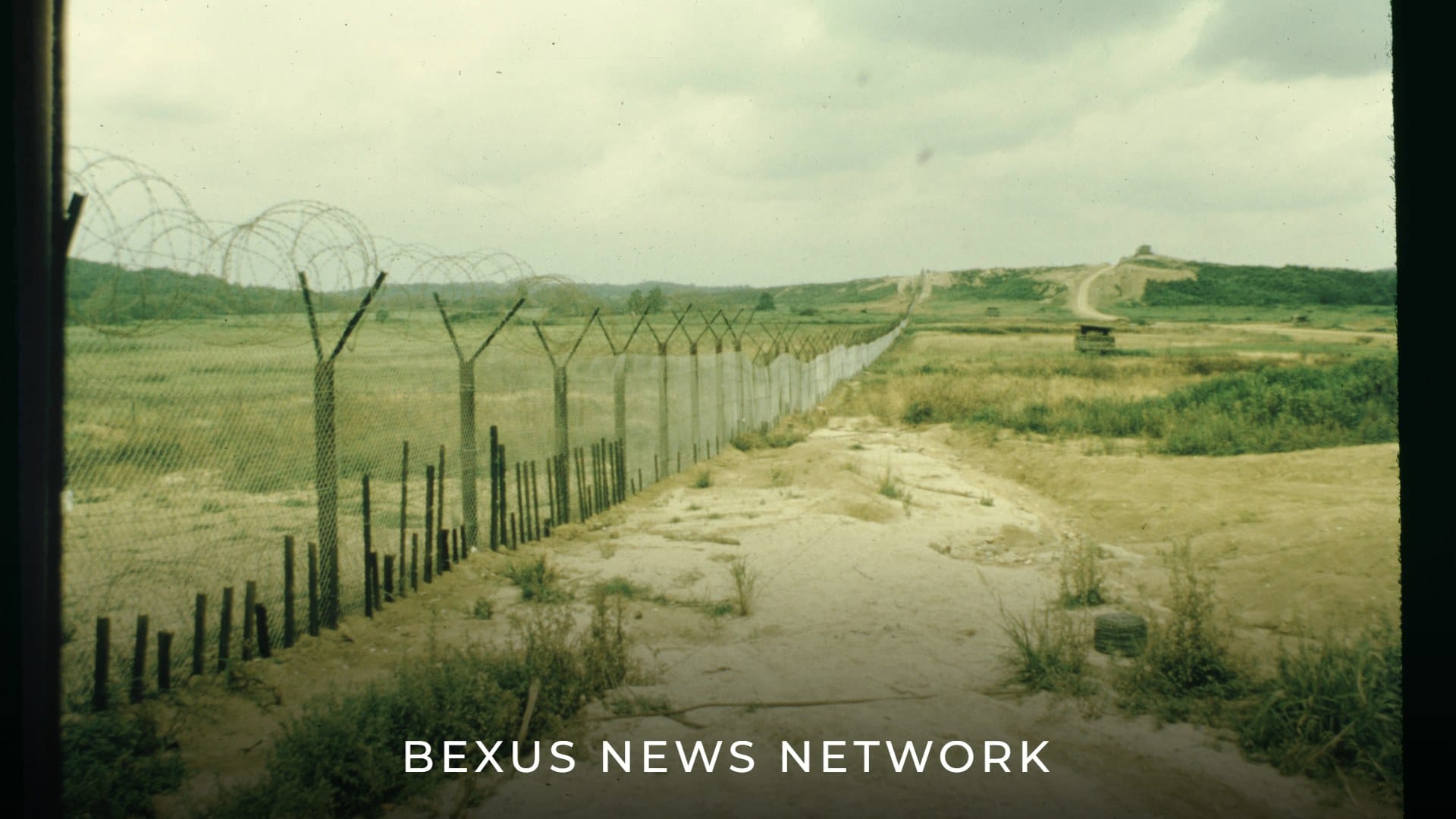
The backdrop to last year's proposal was almost identical to the present one. In the November 2025 statement, Kim stated that "situations in which [North Korean troops] cross the Military Demarcation Line and infringe upon our territory continue to occur" as the North Korean military constructed tactical roads and barbed-wire fences and planted landmines along the MDL. He said the South Korean military was responding "through warning broadcasts and warning shots" in accordance with operational procedures. The stated purpose of proposing talks was to "prevent accidental clashes between the South and the North and ease military tensions."
The Defense Ministry cited the loss of marker signs as the reason for the discrepancy in border awareness between the two Koreas. According to last year's statement, following the signing of the Armistice Agreement on July 27, 1953, MDL marker signs were erected in August of the same year under the supervision of the Military Armistice Commission, but "a significant number have been lost." Maintenance has remained suspended since North Korean troops opened fire in 1973 while UNC personnel were conducting repair work. In 2004, the South Korean military worked with the U.S. National Geospatial-Intelligence Agency (NGA) to calibrate the MDL from the original maps to the actual terrain. The Defense Ministry explained, "We prioritize the MDL marker signs, but when identification is difficult, we apply the MDL coordinate lines from military maps."
Service Members Injured in the Interim by Explosion Involving Landmine Planted South of MDL by North Korea
During the 11 months following the proposal, conditions did not improve. In its October 23 statement, the Defense Ministry disclosed that "on September 21, South Korean service members were injured when a landmine exploded during a search operation conducted by our side in the Demilitarized Zone." It added, "An investigation confirmed that the incident was related to a landmine planted by the North in an area south of the Military Demarcation Line."
In the statement issued 32 days after the explosion, the Defense Ministry used these investigation findings as the rationale for proposing talks. The November statement last year cited the North's landmine planting along the MDL as the reason for proposing talks. Eleven months later, the fact that service members were injured in an explosion involving a landmine planted by the North south of the MDL took its place. The only demand made of the North in the October 23 statement was to hold talks. The location of the explosion reported in the statement was "during a search operation in the Demilitarized Zone," and the location of the landmine was "an area south of the Military Demarcation Line."
Defense Ministry Reports Increase in North Korean Activities and Warning Shots by South Korean Military
The Defense Ministry also noted that tensions in the border area have heightened. The statement said, "The recent increase in North Korean activities along the Military Demarcation Line, as well as our warning broadcasts and warning shots, is not unrelated to this situation." While last year's November statement noted that MDL incursions by North Korean personnel "continue to occur," nearly a year later, both North Korean activities and the South Korean military's responses have "increased."
The Defense Ministry also warned of future dangers. The statement noted, "Considering the reality of military confrontation at the Military Demarcation Line between the South and the North, if this situation continues to be left unaddressed, it is difficult to predict what other situations may arise." It also stated, "Without extraordinary measures, service members will operate based on the locations each perceives, which is a factor that increases the likelihood of accidental clashes."
The Defense Ministry also stated in the release, "Over the past several years, we have closely monitored the North Korean military's construction of tactical roads and barbed-wire fences and planting of landmines along the Military Demarcation Line, as well as incursions across the Military Demarcation Line during that process." This explained that South Korea has observed the North's construction and landmine planting along the MDL for several years. The responses listed in the statement during that period were warning broadcasts, warning shots, and the proposal for talks last November.
President Repeatedly Emphasizes 'Peace That Requires No Fighting' Over Same Period
President Lee Jae-myung repeatedly underscored peaceful coexistence in public remarks following the September 21 landmine explosion. On September 22 (local time), the day after the explosion, President Lee met with UN Secretary-General António Guterres at UN Headquarters in New York. According to Korea Policy Briefing, President Lee explained at the meeting that the South Korean government is striving to build a Korean Peninsula where the two Koreas peacefully coexist and grow together, grounded in the view that "a peace that requires no fighting is the most foolproof security." Secretary-General Guterres replied that he actively supports the South Korean government's foreign policies, particularly its policy for peace on the Korean Peninsula, and that the UN would continue to explore possible roles to ensure these efforts bear fruit. The meeting between the two leaders was their third, following informal talks on the sidelines of the Group of Seven (G7) Summit in June last year and a bilateral meeting during the UN General Assembly in September.
At the South Korea-U.S. summit held in New York on the same day, President Donald Trump reaffirmed his willingness to engage in dialogue with North Korea. Korea Policy Briefing reported, "The South Korean and U.S. leaders agreed to maintain close communication as peacemakers and pacemakers to open the door to dialogue with North Korea and establish sustainable peace on the Korean Peninsula." Wi Sung-lac, director of the National Security Office at Cheong Wa Dae, stated at the New York Press Center that "the leaders of South Korea and the United States held talks for about 30 minutes starting at 7:20 p.m. today." Based on the joint fact sheet from their summit last November, the two leaders also reaffirmed their shared commitment to deepening cooperation in areas including nuclear-powered submarine fuel, enrichment and reprocessing, shipbuilding cooperation, and the transition of wartime operational control (OPCON).
The same stance continued at the 78th Armed Forces Day ceremony held on the runway of Gyeryongdae in South Chungcheong Province on October 1. President Lee said, "While winning a fight is important, winning without fighting is more important, and an even more certain form of security is creating a peace that requires no fighting." President Lee also said, "The South and the North must find a 'path to winning together' for peace on the Korean Peninsula and build trust." He added, "Although the knots in inter-Korean relations are tangled in complex ways, we will continue to untangle these knots step by step with patience," and urged, "We look forward to and urge the North to also join us on the path to restoring trust and resuming severed dialogue."
Korea Policy Briefing reported that President Lee wished a swift recovery on that day to the service members recently injured in an accident in the Demilitarized Zone. President Lee said, "It makes us reflect once more on the fact that this ordinary day we enjoy stands upon someone else's danger." The ceremony took place 10 days after the explosion. At the same event, President Lee said, "Sacrifices made for the country and the community must never end as mere individual sacrifices," adding, "The state will always stand by you so that your dedication and sacrifice lead to honor and pride." He also remarked, "Strong national defense does not come from weapons alone. Your morale is national defense capability itself." Korea Policy Briefing reported that President Lee stated he would guarantee the human rights of service members and fundamentally improve service conditions.
During a joint press statement between South Korea and Egypt on October 8, President Lee also said, "I conveyed to President El-Sisi our government's firm philosophy that creating a peace that requires no fighting is the most foolproof and solid security, far better than winning through fighting." President Lee mentioned that President El-Sisi highly appreciated the South Korean government's efforts to create conditions for dialogue and cooperation and expressed his full support. President Lee also noted, "I explained our government's vision for peaceful coexistence on the Korean Peninsula," adding, "Our two countries agreed to make continuous efforts for peace and stability in the international community, including on the Korean Peninsula and in the Middle East." These remarks came 17 days after the explosion.
Government Explains Resuming Dialogue Is the Way to Prevent Accidental Clashes
The Defense Ministry's explanation is as follows: as long as the South and the North hold different understandings of where the boundary lies, the risk of accidental clashes is bound to grow, and to mitigate this, military authorities must sit down face-to-face to verify the location. This is also the context behind the Defense Ministry's mention of "extraordinary measures" on the 23rd. The explanation is that if service members move according to the boundaries they each perceive, the likelihood of accidental clashes increases.
This time, the Defense Ministry also left open the possibility of three-way talks involving the UNC. The restoration of military communication lines was included in the agenda. Korea Policy Briefing reported in an article covering the Armed Forces Day ceremony that the government stated it would consistently pursue substantive measures to reduce military tensions between the South and the North.
Alongside its dialogue proposal, the government is highlighting the bolstering of military power. In his Armed Forces Day address, President Lee said, "We will advance artificial intelligence and manned-unmanned teaming systems, reorganize the military structure accordingly, and redesign overall defense readiness to make an unequivocal leap forward into a 'smart, elite, and strong military.'" He also said, "By the mid-2030s, we will successfully build nuclear-powered submarines with our own technology." Korea Policy Briefing reported that the government announced plans to strengthen military-led deterrence and response capabilities, and drafted next year's defense budget at 73 trillion won, an 8.2% increase from the previous year. President Lee also said, "We already possess sufficient strength to protect ourselves by our own power."
In the same address, President Lee said, "Going forward, we will place the final period on this by reclaiming wartime operational control, fulfilling the half-century-long dream of self-reliant defense together with the people." He also remarked, "President Park Chung-hee broke ground on the defense industry, saying we should make our own rifles with our own hands, and President Roh Moo-hyun pushed that dream one step further with his commitment to defense reform and wartime operational control." He also mentioned the launch ceremony for the state-of-the-art Aegis destroyer 'Daeho Kim Jong-seo' held in Ulsan the previous day. "From a country that could not properly make a single rifle, we have become a military power that produces and exports cutting-edge tanks, self-propelled howitzers, fighter jets, and naval vessels," he said. President Lee emphasized that "the peace and prosperity of this land are not handed to us by someone else, but are made by ourselves, just as we have done so far," and also expressed gratitude to the troops of the U.S. Forces Korea and UN Command member states.
The administration's North Korea policy framework is also reflected in its national policy agenda. In the national policy tasks listed by Korea Policy Briefing, under National Goal 5, "Foreign Affairs and National Security Centered on National Interest," and Strategy 2, "A Korean Peninsula of Peaceful Coexistence and Prosperity," there are five tasks under the Ministry of Unification, numbered 114 to 118. The first task, No. 114, is "Re-establishing Inter-Korean Relations of Reconciliation and Cooperation and Institutionalizing Peaceful Coexistence." Task 115 is "Promoting Mutually Beneficial Inter-Korean Exchanges and Cooperation with Public Consensus," Task 116 is "Alleviating the Pain of Division and Resolving Humanitarian Issues," Task 117 is "Pursuing Peace and Unification Policy for the Korean Peninsula Together with the Public," and Task 118 is "Preparing the Future of Peace Economy and Shared Growth on the Korean Peninsula." Task 122 under the Ministry of Foreign Affairs is "Seeking Substantive Progress Toward Resolving the North Korean Nuclear Issue and Establishing a Peace Regime on the Korean Peninsula." Under Strategy 1 of the same national goal, there are four tasks under the Ministry of National Defense, numbered 109 to 112. Task 110 is "Transition of Wartime Operational Control Based on All-Directional Deterrence Capabilities Rooted in the ROK-U.S. Alliance," and Task 112 is "Improving Service Conditions for Troops to Boost Military Morale."
Number of Casualties and Incursions Remains Undisclosed
The Defense Ministry has not disclosed the number of service members injured in the September 21 explosion, the number of MDL incursions by North Korean personnel, the number of warning broadcasts and warning shots fired by the South Korean military, the deadline for North Korea to respond to the latest proposal, or subsequent measures if the North ultimately refuses to respond.
Placing the phrasing of the two documents side by side reveals the shifts over the 11-month span. The November 2025 statement stated that incursions across the MDL by North Korean personnel "continue to occur," and the South Korean military's response was "warning broadcasts and warning shots." In the October 2026 statement, both North Korean activities and the South Korean military's warning broadcasts and warning shots "increased," and during that time, South Korean soldiers were injured in an explosion involving landmines laid south of the MDL by the North. Over the same period, the Defense Ministry's response culminated in reproposing talks with an expanded agenda.
The issue of MDL marker signs, which last year's statement noted had been "largely lost," remains unchanged. According to the Defense Ministry's explanation last year, maintenance has remained suspended since the 1973 shooting by North Korean troops. In place of markers, the latest statement used the expression "mutually verify the clear location of the ground Military Demarcation Line." Unless the North responds, service members must continue operating, as the Defense Ministry put it, "based on the locations each perceives."
Sources (KST)
- Ministry of National Defense (Korea Policy Briefing) · 2026-10-23 · Defense Ministry Proposes 'Military Talks' to North..."Consultations on Verifying Military Demarcation Line Location" · https://m.korea.kr/news/policyNewsView.do?newsId=148974228&pageIndex=1&cateId=&repCode_P=&smenu=EDS04
- Ministry of National Defense (Korea Policy Briefing) · 2025-11-17 · Defense Ministry Proposes Military Talks to North..."Discussing Baseline Establishment for Military Demarcation Line" · https://www.korea.kr/news/policyNewsView.do?newsId=148954841
- Korea Policy Briefing · 2026-10-01 · President Lee: "Self-Reliant Defense Is Sovereignty Itself... Will Surely Realize That Dream Through OPCON Transition" · https://m.korea.kr/news/policyNewsView.do?newsId=148972879&pageIndex=1&cateId=&repCode_P=&smenu=EDS04
- Korea Policy Briefing · 2026-09-23 · President Lee Meets UN Secretary-General..."Look Forward to Cooperation for a Korean Peninsula of Peaceful Coexistence" · https://m.korea.kr/news/policyNewsView.do?newsId=148972480&pageIndex=1&cateId=&repCode_P=&smenu=EDS04
- Korea Policy Briefing · 2026-09-23 · South Korea, U.S. Leaders "Welcome Progress in U.S. Investment Discussions"... Follow-up Talks on Nuclear Sub Fuel, OPCON Transition · https://m.korea.kr/news/policyNewsView.do?newsId=148972551&pageIndex=1&cateId=&repCode_P=&smenu=EDS04
- Office of the President (Korea Policy Briefing Speeches) · 2026-10-08 · 10/8 (Thu) South Korea-Egypt Joint Press Statement · https://m.korea.kr/briefing/speechView.do?newsId=132039106&pageIndex=1&cateId=&srchType=&srchWord=&repCode_Z=
- Korea Policy Briefing National Policy Tasks · Checked 2026-10-24 · List of National Policy Tasks · https://www.korea.kr/govVision/index.html