Hegseth Strengthens Defense Cooperation with Guyana to Counter Narco-Terrorism… Signs Joint Declaration at Pentagon, Bolsters Joint Exercises and Critical Minerals Cooperation
WASHINGTON
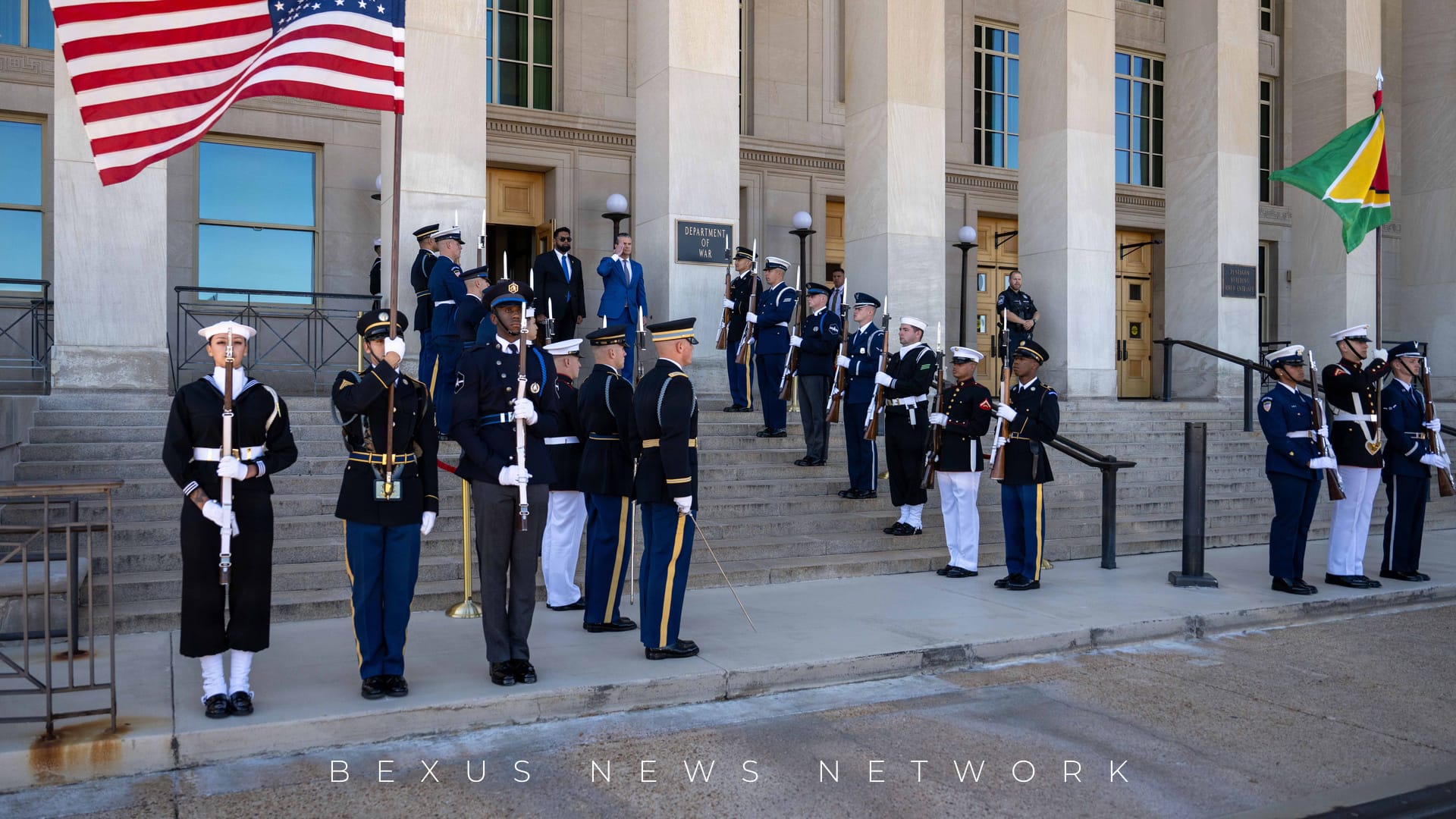
The United States and Guyana are strengthening defense cooperation centered on countering narco-terrorism. U.S. Secretary of War Pete Hegseth met with Guyanese President Mohamed Irfaan Ali at the Pentagon on October 21 (local time) to jointly sign a "Joint Declaration for an Enhanced Defense Partnership." The two leaders also addressed military-to-military interoperability and the resilience of their defense industrial base, with the Department of War stating that the declaration will bolster security across the Caribbean.
Secretary Hegseth and President Ali Signed Joint Declaration at Pentagon on October 21
Bilateral talks commenced following the playing of both nations' national anthems. President Ali's official title is President of the Co-operative Republic of Guyana and Commander-in-Chief of the Armed Forces. Secretary Hegseth welcomed President Ali on his visit to the Pentagon. The Department of War described the signing of the "landmark" joint declaration as an effort to take bilateral defense cooperation to the next level. Sean Parnell, Assistant to the Secretary of War for Public Affairs and chief spokesman, announced the signing on X the same day. He wrote that the two nations are strengthening their ability to confront narco-terrorist networks, secure the Caribbean, and defend their shared neighborhood. A 48-second video was attached to the post.
Today, @SECWAR and @Presidentaligy signed a landmark Joint Declaration at the Pentagon establishing an Enhanced Defense Partnership between the United States and Guyana.
— Sean Parnell (@SeanParnellASW) 2026년 10월 21일
Together, our two nations are strengthening our ability to confront narco-terrorist networks, secure the… pic.twitter.com/yAtz6ZCGkI
Secretary Hegseth first expressed his gratitude to President Ali, noting that Guyana has demonstrated regional leadership in countering narco-terrorism as a founding member of the Counter-Cartel Coalition of the Americas. President Ali emphasized the "strong and enduring defense partnership" between the two nations.
During the meeting, the two discussed two specific areas. One was how to enhance interoperability—the degree to which equipment and operational procedures integrate when the armed forces of both nations operate together. The other was how to bolster the resilience of their defense industrial bases to benefit both nations.
Guyana's Department of Public Information reported the same day that the declaration, titled the "Joint Declaration for an Enhanced Defense Partnership," was signed on Wednesday, October 21. What actions will the two nations actually pursue under this declaration? Based on descriptions provided respectively by the Department of War and the Guyanese government, the focus centers on training and technical expertise.
Department of War to Expand Multi-Domain and Air Interdiction Training with Guyana
The Department of War explained that it is expanding joint training with Guyana in the areas of multi-domain operations and air interdiction. Multi-domain operations involve conducting operations across land, sea, air, and other domains simultaneously. Air interdiction operations focus on disrupting aerial transit routes. Increased joint training between the two nations in these two areas formed the core of the Department of War's explanation regarding training.
Details provided by Guyana's Department of Public Information were more specific. According to the department, the Department of War committed to providing the Guyana Defence Force with ongoing defense expertise, multi-domain training, and joint exercises. The department noted that the declaration also includes provisions to enhance Guyana's air domain awareness capabilities, representing the Guyanese government's account of the agreement.
Secretary Hegseth remarked that this effort is "just the beginning." He stated that President Ali's investments have provided confidence to the United States, while U.S. investments have similarly provided confidence to Guyana's security forces and military. Building upon this confidence, he noted that the landmark joint declaration signed that day elevates the two nations' "all-domain partnership."
Secretary Hegseth told President Ali, "Your leadership in the region, particularly alongside key Caribbean partners, has been indispensable." He added, "Nations look to you. You have taken the lead and laid the groundwork for what we are doing in the Western Hemisphere." What, then, is the threat targeted by "what we are doing"?
Secretary Hegseth Cites Narco-Terrorism and Extra-Hemispheric Military Influence as Common Challenges
The Department of War cited narco-terrorism and military influence originating from outside the Western Hemisphere as shared challenges facing both nations. Secretary Hegseth stated that the two nations will jointly defeat these threats in the course of executing President Donald Trump's corollary to the Monroe Doctrine.
The Monroe Doctrine is a principle articulated in 1823 by President James Monroe declaring that the United States would not tolerate new colonial ventures by European powers in the Western Hemisphere. Secretary Hegseth also referenced this declaration at the counter-cartel conference on March 5 of this year. At the time, he said, "We want our borders and territories secure; we want unfettered access to key terrain and trade routes so our nations can industrialize; and we want our shared neighborhood free from outside powers threatening our peace and independence."
On this occasion, Secretary Hegseth explained the objectives of this direction directly to President Ali. He stated that with the right tools in place, both nations can address these challenges, thereby advancing Guyana's sovereignty, its people, security, and prosperity alongside the United States.
President Ali stated in the same meeting that much had been discussed regarding security and stability for a long time. He remarked that what Secretary Hegseth is pursuing is precisely what is essential for the region's long-term prosperity and stability. He emphasized that the region must be "free from drug trafficking, free from international actors that are harmful to the region, free from terrorism, and free from the idea that any group or organization in the world can use this region as a safe haven."
President Ali characterized the present moment as "an era of action, an era of leadership, and an era of resolve and commitment." He added, "I am very pleased to be part of this partnership," and stated that he looks forward to working with the United States "in a stronger way."
Critical Minerals MOU Backs Shared Defense Industrial Base
The Department of War also addressed critical minerals during the meeting. The department explained that Guyana's pursuit of a memorandum of understanding (MOU) on critical minerals with the United States is vital to the collective security of both nations. Once established, this agreement would strengthen the shared defense industrial base of the two countries. As described by the Department of War, the MOU is currently being pursued by Guyana.
The defense industrial base directly ties into earlier topics of discussion. Military equipment requires an unbroken supply chain from raw materials to finished products, and critical minerals serve as the starting point of that supply chain. The Department of War placed the resilience of the defense industrial base on the meeting agenda and highlighted the critical minerals MOU as a key instrument to fortify that foundation.
The context that binds training, the industrial base, and critical minerals under a single declaration stems from the framework established by the United States in March of this year, which brought together nations across the Western Hemisphere. Guyana is a founding member of that framework.
Seventeen Nations Signed Joint Security Declaration at Doral Conference on March 5
On March 5, the Department of War convened the inaugural Counter-Cartel Conference of the Americas at the headquarters of U.S. Southern Command in Doral, Florida. Defense and security leaders from the Caribbean, Central America, and South America gathered as Secretary Hegseth and representatives from 17 Western Hemisphere nations signed a joint security declaration. The declaration reaffirmed commitments to regional peace, sovereignty, and stability.
Secretary Hegseth made the intent clear starting with the conference's title, emphasizing that it was not "America's Counter-Cartel Conference," but the "Counter-Cartel Conference of the Americas"—signifying an effort shared by all nations across the region. At the conference, he underscored the scale of the challenge with figures, stating that the human smuggling industry had grown by up to 2,000 percent over five years, from $500 million in 2018 to $13 billion in 2022. He also noted that while the Western Hemisphere accounts for one-eighth of the world's population, it accounts for one-third of violent crime. Conversely, he asserted that this trend is being reversed under President Trump's defense strategy, pointing to significant reductions in illegal border crossings at the U.S. southern border, successful narco-terrorism interdiction operations across the Caribbean since September of last year, and a 56 percent decrease in the flow of fentanyl into the United States.
He characterized past U.S. foreign policy as "benign neglect," prioritizing foreign theaters and foreign borders over its own. That direction has now shifted, he said. He stated that the United States is prepared to go on the offensive alone if necessary, but stressed that "our preference, and the purpose of this conference, is for all of us to do it together for the benefit of this hemisphere." He called for reviving the approach known during World War II as "Quarter-Sphere Defense" and asked partners in the Southern Hemisphere to increase burden sharing. Increased burden sharing was a direct request made by Secretary Hegseth to partner nations at the meeting. He also stressed that border security must be the top priority for every nation in the hemisphere. Emphasizing that Western Hemisphere nations have always been bound by heritage, history, and geography, he highlighted the importance of defending shared Western values. The address concluded by invoking President Monroe's enduring vision, stating that with President Trump in the White House and participating nations united, "we can make the Americas great again in our time."
The vision formulated at the Doral conference took institutional shape two days later as a coalition.
Coalition Launched by President Trump on March 7 Limits Foreign Geopolitical Interference
On March 7, President Trump launched the Counter-Cartel Coalition of the Americas, also referred to as the "Shield of the Americas." The Department of War describes this coalition as a U.S.-led multinational security and political coalition established to combat transnational drug cartels, curb illegal immigration in the Western Hemisphere, and limit foreign geopolitical interference.
On June 15, President Daniel Noboa of Ecuador visited the Pentagon. Secretary Hegseth expressed gratitude to President Noboa, noting Ecuador's status as a founding member of the coalition. He stated that the March launch event was "only the beginning," and affirmed that the Department of War would translate into operational action its capabilities to eradicate narco-terrorist trafficking and dismantle networks across Central and South America, including Ecuador.
Secretary Hegseth told President Noboa that "what means the most to President Trump are nations that step up and pull their own weight." President Noboa responded that while Latin American nations do not always look in the same direction, striving for ongoing cooperation remains critical because transnational criminal adversaries always operate in concert.
President Noboa added that extremist elements in the Western Hemisphere are pushing back and adapting to national security operations, necessitating rapid action to stay ahead. He noted his preference for trade and investment over aid, explaining that profitable commercial endeavors can support and fund regional security operations. With U.S. support, investment, and combined operations, he said, regional security challenges can be solved and the hemisphere secured. Secretary Hegseth replied, "Excellent. I look forward to advancing that discussion today."
Following the 17-nation declaration on March 5, the coalition launch on March 7, and the bilateral meeting with Ecuador's president on June 15, President Ali of Guyana—a founding member of the coalition—visited the Pentagon on October 21. This also explains why Secretary Hegseth first conveyed his appreciation to President Ali. The Guyanese government separately detailed the strategic significance of the declaration.
Guyanese Government Explains Declaration Is Essential to Preserving Sovereignty and Territorial Integrity
Guyana's Department of Public Information reported that the declaration builds upon Guyana's decades-long partnership with the United States. The department explained that the declaration is "essential to continuing to preserve Guyana's sovereignty and territorial integrity." It noted that the agreement also demonstrates the strategic importance both nations place on the security of Guyana and the Western Hemisphere. President Ali likewise posted on his personal account the same day that he had signed the joint declaration with Secretary of War Hegseth at the Pentagon in Washington, D.C., writing that the declaration builds on a multi-decade partnership with the United States.
Today, I signed a Joint Declaration for an Enhanced Defense Partnership with United States @SecWar Pete Hegseth at the Pentagon in Washington, D.C.
— President Dr Irfaan Ali (@presidentaligy) 2026년 10월 21일
This landmark declaration builds on our multi-decade partnership with the United States and represents an important step in… pic.twitter.com/50L3DRpVjn
The department stated that the declaration supports Guyana's efforts to establish a modern, strategic defense architecture. Cooperation on air domain awareness strengthens Guyana's capacity to monitor, deter, and respond to threats within its territory and surrounding areas. The declaration also aligns Guyana and the United States in confronting narco-terrorist organizations and illicit narcotics trafficking.
The department emphasized that this declaration sends an unequivocal message of readiness to deter "malign state and non-state actors" who threaten the peace and security of Guyana and the wider region. As Guyana expands its role as a regional leader in the Western Hemisphere, the department stated that the partnership rests on a shared commitment to the prosperity, security, and sovereignty of both nations' peoples. It also noted that the declaration marks the latest milestone in an expanding bilateral strategic relationship encompassing security, energy, trade, and investment.
The accounts provided by the Department of War and the Guyanese government point to the same framework. Both placed countering narco-terrorist organizations at the core of the declaration, citing joint training, air domain awareness, and the defense industrial base as instruments of cooperation.
The Department of War outlined three main pillars of cooperation emerging from this meeting: first, joint training centered on multi-domain operations and air interdiction; second, enhancing interoperability and the resilience of the defense industrial base; and third, reinforcing the collective security of both nations through a critical minerals MOU. Underlying these three pillars is the shared determination to jointly counter narco-terrorism and extra-hemispheric military influence.
Sources (KST)
- U.S. Department of War · https://www.war.gov/News/News-Stories/Article/Article/4630733/hegseth-guyanese-president-establish-enhanced-military-partnership/
- X @SeanParnellASW · https://x.com/SeanParnellASW/status/2113022890924990546
- X @presidentaligy · https://x.com/presidentaligy/status/2113033285148528730